Funny Faces: A French Game for Feelings and Face Words
Make a funny face, then say how it feels. Learn the face words in English and French.
Getting the game ready...
For grown-ups
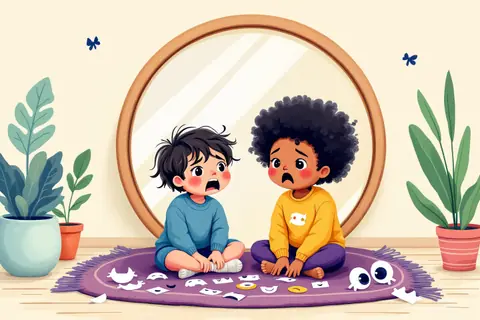
This game asks a child to build a face from parts: a pair of eyes, two eyebrows, a mouth, a nose and some hair. Once the face is put together, the child decides what that face is feeling. Every part and every feeling has its English word and its French word, and a listen button says the French out loud. It suits children of about 4 to 8, and it is gentle enough for a child who has never heard a word of French. Older kids in French immersion often use it to check the spelling of words they already say every day.
There are really two vocabularies in play. The first is the face: les yeux (the eyes), les sourcils (the eyebrows), la bouche (the mouth), le nez (the nose) and les cheveux (the hair). The second is feelings: content (happy, pleased), triste (sad), fâché (angry, cross), surpris (surprised) and fatigué (tired). The fun is in the mismatch. Put sleepy eyes with a huge open mouth and you get a face that could be surprised or could be yawning, and suddenly a six-year-old is arguing with you about it. That argument is the learning.
Why feelings words matter, in any language
Children feel plenty long before they can name it. A child who can say "I was frustrated" or "I felt left out" has a handle on the day that a child with only "good" and "bad" does not. Building a face and choosing a feeling gives children a low-stakes way to practise those words, because the face on the screen is having the feeling, not them.
Doing it in two languages adds something else. A child in French immersion may spend the whole school day in French and then come home with no French words for how the day went. Once triste and fâché are familiar, a child can tell you, in either language, which part of the day felt which way. Many families find the French words a little easier at first, oddly, because they feel like a game rather than a confession.
How to say the words (for parents who never learned French)
You do not need good French to play this with your child. Press the listen button, say the word after it, and let your child correct you. Being corrected by a seven-year-old is excellent for the seven-year-old.
These plain spellings get you close:
| French | Say it like | English |
|---|---|---|
| les yeux | lay ZYUH | the eyes |
| les sourcils | lay soor-SEE | the eyebrows |
| la bouche | lah BOOSH | the mouth |
| le nez | luh NAY | the nose |
| les cheveux | lay shuh-VUH | the hair |
| content | kohn-TAHN | happy, pleased |
| triste | TREEST | sad |
| fâché | fah-SHAY | angry, cross |
| surpris | soor-PREE | surprised |
| fatigué | fah-tee-GAY | tired |
Three small things trip up English speakers. The final consonant is usually silent, so sourcils ends on "see" and surpris ends on "pree". The "eu" in cheveux and yeux is a rounded "uh", said with your lips pushed forward as if you were about to whistle. And the "on" and "an" in content are nasal: you stop before touching the "n", letting the sound hum through your nose. If you are not sure, the listen button is always right and you can press it as often as you like.
You will also notice les yeux sounds like "lay zyuh". French links the "s" of les to the vowel that follows, so it comes out as a "z". Kids pick this up by ear long before anyone explains it.
Boy words and girl words, explained lightly
Sooner or later your child will hear a teacher say contente instead of content, and ask why. In French, describing words change a little depending on who they describe. For a boy (or a word that is masculine), you say il est content (he is happy). For a girl, you say elle est contente (she is happy), and that final "t" now gets said: kohn-TAHNT.
| For a boy | For a girl | What changes when you say it |
|---|---|---|
| content (kohn-TAHN) | contente (kohn-TAHNT) | the "t" is now heard |
| fâché (fah-SHAY) | fâchée (fah-SHAY) | spelling only, sounds the same |
| surpris (soor-PREE) | surprise (soor-PREEZ) | a "z" sound at the end |
| fatigué (fah-tee-GAY) | fatiguée (fah-tee-GAY) | spelling only |
| triste (TREEST) | triste (TREEST) | nothing at all |
That is all a young child needs. Do not drill it. When your daughter says je suis content, you can simply answer oh, tu es contente! and let her hear the difference. Young children sort these patterns out through lots of listening; a grammar lesson at this age mostly produces glazed eyes.
Playing it together
Take turns. One person builds a face, the other person names the feeling, in French if they can and in English if they cannot. Then swap. Ask "why?" every so often: "Why is he fâché?" "Because his eyebrows go down like this." Now your child is noticing that eyebrows carry a lot of the feeling, which is true and useful when reading real faces too. Then invent a reason: "She is surprise because a duck walked into the kitchen."
Making it easier
- Stick to two feelings at first, content and triste, and add one more each session.
- Say the English and French together every time: "Happy, content."
- Let your child just point to the right face while you say the word.
Making it harder
- Ask for a full sentence: il est fatigué (he is tired), elle est triste (she is sad).
- Build a face that shows two feelings at once and talk about it.
- Older kids can try j'ai peur (I am scared, literally "I have fear") and je suis fier or fière (I am proud).
The mirror game, no screen needed
Sit side by side in front of a mirror. Call out a feeling in French and both of you pull that face: Fais une tête triste! (Make a sad face!) Then hold the face and point at the parts. "Where are your sourcils right now?" Sad eyebrows tilt up in the middle, angry ones pull down. Children find this hilarious, and it fixes the face words to their own faces.
For a paper version, cut out a few pairs of eyes, eyebrows and mouths from scrap paper, about three of each. Lay a paper plate on the table and let your child build faces with the pieces, naming each part as it goes down.
What to watch for
Notice whether your child can name the parts in French without the English first. That is the sign the words are settling in. If you find yourself always translating, try pausing for a second before you give the English, and see if the French arrives on its own.
Watch, too, for the moment a child uses a feelings word for real. "I'm fatigué" at bedtime counts. So does a grumpy je suis fâché when the crayons get put away. Treat that as a small win and answer in kind.
If your child enjoys this, the Word Pairs memory game uses the same listen-then-match idea with animals, colours and food. And for a gentler wind-down, the read-aloud stories in the Story Corner are a good place to hear feelings words used in a real story. More ideas for French at home are collected under French at Home.