Spelling Snake: A Letter-Order Game for Sight and Phonics Words
Steer the snake to gobble the letters in the right order and spell the word you hear.
Getting the game ready...
For grown-ups
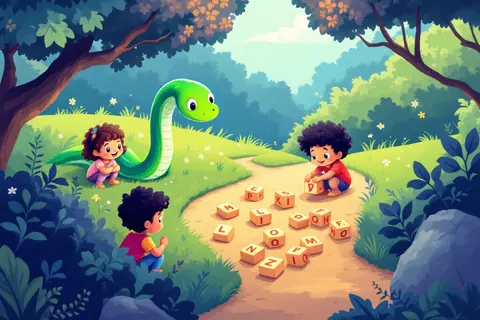
Spelling Snake asks a child to do one thing carefully: hear a word, look at its picture, and then collect the letters in the order they belong. The snake grows with each correct letter, and the word builds up along its body. That is the whole game, and it is a good one for children from about the end of Kindergarten to Grade 2, plus older children who are starting French and want to see how simple nouns are spelled.
What makes it useful is the order. A child can recognise "cat" as a shape on a page without knowing much about it. To steer a snake to the c, then the a, then the t, they have to think about which sound comes first, which comes next and which comes last. That is the same work their eyes and mouth do when they read a new word from left to right.
Why spelling in order helps reading
Reading and spelling run on the same knowledge: which letters stand for which sounds. When a child reads "sun", they turn letters into sounds and blend them. When they spell "sun", they go the other way, splitting the word into sounds and choosing a letter for each one. Practising the second direction makes the first one sturdier.
Children who are early in reading often know all the letters in a word but put them in a jumble. You might see "snu" or "nus" on a birthday card. That is not carelessness. It usually means the child heard the sounds but has not yet learned to hold them in sequence. Spelling Snake slows the process down, one letter at a time, so the sequence becomes the thing they are practising.
The word lists
The game draws on three kinds of words. It helps to know which one your child is on, because each asks for something slightly different.
| Word list | Examples | What your child is practising | Typical fit |
|---|---|---|---|
| Short phonics words (consonant, vowel, consonant) | cat, hop, sun, bed, pig | Hearing three sounds and matching each to a letter | Kindergarten to Grade 1 |
| Common sight words | the, said, was, you, they | Remembering spellings that do not follow the usual sound pattern | Grades 1 and 2 |
| Simple French nouns | chat (cat), lit (bed), pomme (apple) | Seeing how French letters map to French sounds, with the English meaning shown | French immersion or beginners, any age |
Start with the short phonics words even if your child already reads a little. They are the easiest place to feel the "first sound, middle sound, last sound" rhythm. Sight words come next, because several of them break the rules: "said" sounds like it should be spelled "sed", and a child who has learned to trust sounds needs a moment to accept that.
The French mode is a quiet bonus. A word like chat ends in a t that is not pronounced, so the game teaches, gently, that French spelling has silent endings. If your child is in French immersion, this mode pairs well with the Word Pairs memory game, which matches English and French words.
Playing together
Sit beside your child for the first few words. Before they move the snake, say the word slowly and stretch it: "ssss, uuuu, nnnn". Then ask, "What sound do you hear first?" Let them find that letter. After the first letter, ask again: "And then?"
A short exchange might go like this:
Grown-up: The picture is a pig. Pig. What do you hear at the start? Child: P! Grown-up: Go get it. Now say it again, slowly. Child: P... i... g. The i! Grown-up: Yes. And the last one? Child: G. Like gorilla.
Notice that the grown-up never spells the word. The child does the thinking; you just keep the sounds in the air. Once your child has the rhythm, you can step back and let them say the sounds to themselves.
Keeping it calm: speed and frustration
Some children love the snake and some children find it stressful, because it keeps moving. If you see shoulders creeping up or a tight jaw, slow the snake down. The goal is spelling, not reflexes, and a slow snake gives the child time to think about the next letter rather than just dodging.
Other things that help:
- Stop after five or six words. A short, successful round is worth more than a long one that ends in tears.
- Let your child say each letter out loud as the snake eats it. Hearing themselves helps them keep their place.
- If a word goes wrong twice, do it together on paper and then come back to it.
The same words with magnetic letters
Away from the screen, a set of magnetic letters on the fridge or a baking sheet does the same job beautifully. Put out only the letters you need, plus one or two spares. For "hop", set out h, o, p and a stray a.
- Say the word. Your child pulls down the letter for the first sound.
- Say it again. They add the middle sound.
- They add the last sound and run a finger under the word while reading it back.
- Change one letter: swap h for t and read "top". Then o for a: "tap". Then t for z: "zap". (Ask, "Is that a real word?" Children love deciding.)
That last step, changing one letter at a time, shows a child that words are built from parts they can swap. It is hard to show on a screen and easy to show with a fridge.
Spelling practice or memorising shapes?
There is a difference between a child who spells "was" because they know its three letters in order and a child who recognises "was" as a familiar blob. Both are useful for reading, but only the first one holds up when the child has to write the word.
You can tell which you are seeing. Ask your child to spell the word out loud without looking. If they can say "w, a, s" in order, the spelling is really theirs. If they can read it but not spell it, keep it in the game a while longer. For sight words especially, a few days of spelling them in order, then writing them once on paper, is what moves a word from "I recognise it" to "I know it".
What to watch for
Watch for a child who always gets the first letter and then guesses. That is common and fine: it means they hear beginnings well and need more practice with the middle sounds. Vowels are usually the hardest, since "pin", "pen" and "pan" sound close. Say the word slowly with an exaggerated mouth and let them watch your lips.
If your child likes listening while looking at words, the Listen and Read player highlights each word as it is spoken, which is a good next step once a child can spell a handful of short words. And for a spelling break with a different kind of game, the Mosquito Swat Quiz is quick and silly.
A good sign of progress is small: one day your child will spell "pig" on a drawing without asking you how.