Story Bubbles: A Comic-Strip Game for Building Sentences
Look at the comic picture and tap the word bubbles in order to tell what is happening.
Getting the game ready...
For grown-ups
In Story Bubbles, a comic panel shows a small scene (a cat on a fence, two friends in the rain) and a handful of word bubbles drift across it. Your child taps the bubbles in order to build the sentence that matches the picture. The sentence has to start with the word that carries the capital letter and finish with the right punctuation mark. It suits children from about Grade 1, when they are reading short sentences, up to Grade 3, when questions and exclamations start turning up in their own writing.
The skill underneath is what teachers often call sentence sense: the feeling that words go in a certain order, that a sentence is a complete thought, and that it has a clear beginning and end. Children pick this up from talk long before they can write it, but seeing the words as separate pieces and putting them back together makes the pattern visible.
The three levels
| Level | Example sentence | What it adds |
|---|---|---|
| 1: Simple sentences | The dog runs. | Who did it, what they did, a capital and a period |
| 2: Describing words | The big brown dog runs fast. | Words that tell more, and where they sit in the sentence |
| 3: Questions and exclamations | Can the dog swim? What a huge splash! | Changing the order for a question, and choosing ? or ! |
Level 2 is where most children slow down, and that is a good thing. "The brown big dog" sounds wrong to an English speaker, even a six-year-old, but they may never have stopped to notice it. When they try it in the game and the picture does not accept it, they hear the problem. Let them say both versions out loud and decide which sounds right.
Level 3 is where word order really changes meaning. "The dog can swim." becomes "Can the dog swim?" with only two words swapped. That is a lovely thing for a child to discover with their own fingers.
Why comic strips work for reluctant writers
A child who freezes at a blank page will often happily fill a speech bubble. The bubble is small, so the job feels small. The picture already tells the story, so the child does not have to invent everything. And comics are a kind of reading many children choose on their own, which gives the activity a little of the feel of a treat rather than a worksheet.
The bubbles also break writing into a size a child can manage. Instead of "write a sentence about this picture", the task is "put these five words in order". Once that feels easy, the step up to "now write your own bubble" is much shorter.
Playing together
Before tapping anything, look at the picture together and say what is happening in your own words. "Oh, the cat is sitting on the fence. Look at its tail." Then let your child look at the bubbles. Often they will find the sentence just by remembering what you both said.
If they get stuck, ask two questions, always in this order:
- "Who is the sentence about?" That usually gives the first word or two.
- "What are they doing?" That gives the action.
Everything else fits around those two parts. A child who knows the who and the what can usually place the describing words by ear.
Capital letters and end marks, explained simply
You do not need grammar terms for this. Here is the plain version I use:
- A capital letter says "a new sentence starts here". Names always get one too, wherever they are.
- A period says "this thought is finished, stop for a breath".
- A question mark says "I am asking something, and I want an answer". Your voice goes up at the end.
- An exclamation mark says "this is loud, surprising or exciting". Your voice gets bigger.
A fun check is to read the finished sentence in the voice the mark asks for. "Can the dog swim?" with a rising voice. "What a huge splash!" with a big voice. If the voice does not fit, the mark is probably wrong.
Paper strips: the off-screen version
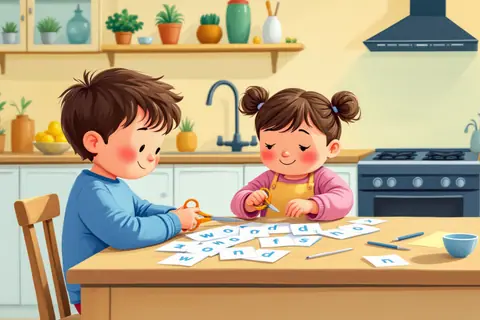
This is one of the easiest reading activities to set up at home. You need a strip of paper, a marker and scissors.
- Write a sentence about something real from your child's day: "We ate soup for lunch."
- Read it together, pointing at each word.
- Cut the strip into words. Cut the period off as its own little square.
- Mix them up and let your child put the sentence back in order.
- Read it back. Then try swapping pieces: "Soup ate we for lunch." Ask, "Does that make sense?"
For a level 2 version, write one or two extra words on new pieces ("hot", "tomato") and ask where they could go. "We ate hot tomato soup for lunch." For level 3, give them a question mark square and ask them to turn the sentence into a question. "Did we eat soup for lunch?" needs a new word, which is a good puzzle.
Keep the pieces in an envelope. A small collection of family sentences makes a good five-minute activity on a slow evening.
From building sentences to writing captions
Once your child is comfortable building sentences, move to writing them. A gentle sequence:
- Draw a simple comic panel together (stick figures are fine) and write the first word of the caption for them. They finish it.
- Next time, they write the whole caption and you check the capital and end mark together.
- Then try a three-panel strip: beginning, middle, end. One sentence under each panel.
Do not correct every spelling at this stage. If the sentence makes sense, has a capital at the start and a mark at the end, that is the target. Spelling can be its own practice, and the Spelling Snake game is a good place for it.
What to watch for
Some children always put the describing word after the noun ("the dog big"). If your child also hears French at school, this can be a sign of the two languages talking to each other, since many French adjectives come after the noun: un chien noir (a black dog, word for word "a dog black"). It is not a problem. Point out, cheerfully, that English and French do it differently, and maybe play the Word Pairs game to see more of both languages side by side.
Watch also for a child who taps the bubbles quickly without reading. If the picture and sentence do not match in their head, slow down and ask them to read the finished sentence aloud before checking it. The sentence they say is the one they have really built.
A good marker of progress: your child starts adding a question mark to a note they write you, all on their own.