Word Pairs: An English and French Memory Matching Game
Turn over two cards at a time. Match each English word with its French partner.
Getting the game ready...
For grown-ups
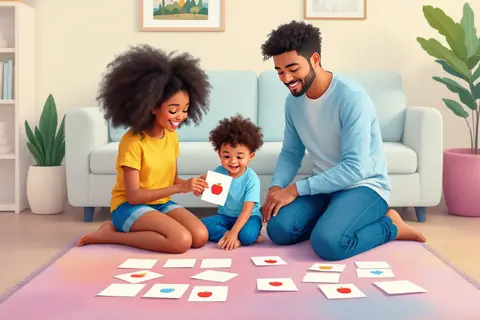
This is the old memory game of turning over two cards at a time, with one twist: the pairs are not two identical pictures but an English word and its French partner. Le chat goes with "the cat", rouge goes with "red", trois goes with "three". A listen button says each French word, so a child hears it every time the card flips. The sets cover animals, colours, numbers, food and school things. It suits children from about 5 who are starting French, and it is just as useful for an eight-year-old in immersion who knows the words out loud but has not seen them written down.
Parents who do not speak French can play it as equal partners. You will both be guessing at first, and that is part of the charm.
Why matching pairs helps words stay
Memory games make a child hold a card in mind for a few seconds, then go looking for its partner. Each time a child thinks "where was the cow?" and turns over the right card, the French word gets pulled back out of memory and joined to the English one. Pulling a word back out is what makes it stick, much more than seeing it again on a list.
The game also gives each word a place. Children often remember "the poisson card was in the corner by the lamp" before they remember the word on its own. That is fine. The place is a hook to hang the word on, and the hook drops away once the word is known.
The word sets and their little articles
French nouns come with a small word in front: le, la, l' or les. Most of the cards show it, and it is worth saying it every time, because the article is part of the word in French. Children who learn pomme without la have to learn the la again later.
| Set | French on the card | Say it like | English |
|---|---|---|---|
| Animals | le chat | luh SHAH | the cat |
| Animals | la vache | lah VAHSH | the cow |
| Animals | l'oiseau | lwah-ZOH | the bird |
| Colours | rouge | ROOZH | red |
| Colours | vert | VAIR | green |
| Colours | jaune | ZHOHN | yellow |
| Numbers | deux | DUH | two |
| Numbers | cinq | SANK | five |
| Food | la pomme | lah PUM | the apple |
| Food | le fromage | luh froh-MAHZH | the cheese |
| School things | le crayon | luh kray-OHN | the pencil |
| School things | les ciseaux | lay see-ZOH | the scissors |
A quick guide to the four little words:
- le (luh) comes before masculine words: le chat.
- la (lah) comes before feminine words: la vache.
- l' is used before a vowel sound, whatever the gender: l'oiseau, l'école.
- les (lay) means "the" for more than one: les ciseaux.
There is no reliable rule for which words are masculine or feminine. Nobody expects a six-year-old to know why a cow is feminine and a cat is masculine. Just say them together, the way French speakers do.
One Canadian note for school things: in Canada, an eraser is usually une efface. In France it is une gomme. If your child's teacher says efface, use that at home.
Playing together, step by step
- Start with one set and six pairs, not the whole deck. Twelve cards is plenty for a first game.
- Before you flip anything, press the listen button on a few words together and repeat them.
- Take turns. When you turn over a French card, say the word out loud, even if you are not sure. Then press listen and say it again.
- When you find a pair, the finder says both words: "La pomme, the apple."
- Stop while it is still fun. Two or three rounds, about ten minutes, is a good session.
If your child is far ahead of you, let them be the French expert and you ask "how do I say that one?" That flips the usual roles and children love it.
Easier
Play face up first. Lay all the cards out showing, match them together, then turn them over and play the memory version with the same cards.
Harder
Hide the English. Play with only French cards and the pictures, or say the English word and have your child find the French card without help. Older children can sort the matched French cards into piles of le words and la words.
Making your own cards at home
You need index cards or a cereal box cut into rectangles, a marker and some crayons. Make a set around something your child cares about. Here is a breakfast set of eight cards, four pairs:
| Card A | Card B |
|---|---|
| a drawing of milk, "the milk" | le lait (luh LAY) |
| a drawing of bread, "the bread" | le pain (luh PAN, nasal) |
| a drawing of an egg, "the egg" | l'œuf (LUHF) |
| a drawing of juice, "the juice" | le jus (luh ZHOO) |
Write the French clearly, with its article and accents. If you are unsure of a spelling or a sound, check it in the game or a picture dictionary before you make the card. A home-made set becomes a game the child is proud of, and you can play it at the kitchen table while dinner cooks.
Short sessions, often
Words stay best when you come back to them after a gap, just before they are forgotten. In plain terms: a little bit, then a rest, then a little bit again. Here is a simple week with one set:
| Day | What to do | Time |
|---|---|---|
| Monday | Play six pairs, face up first | 10 minutes |
| Tuesday | Same six pairs, memory version | 5 minutes |
| Thursday | Same six, plus two new pairs | 10 minutes |
| Sunday | Quick quiz: you say English, child says French | 3 minutes |
| Next Wednesday | Play the whole set once | 10 minutes |
Notice the gaps grow. That growing gap is the trick. Words that come back easily after a week are well on their way.
What to watch for
Listen for the article. If your child says chat and never le chat, gently say the whole thing back. Watch for confusions between look-alike words, such as vert (green) and verre (glass). Those sound the same and only spelling or context tells them apart, so it is a good sign when an older child asks about it.
And watch for words leaking out of the game. A child who says "pass the fromage" at lunch has learned it. Answer with voilà, le fromage and pass the cheese.
When your child wants to hear the words in a sentence, the Listen and Read player reads short texts aloud while the words light up. For more ideas like this one, browse French at Home or the full list of games.