Spot the Difference: A Careful Looking Game for Kids
The two pictures look the same, but five things are different. Can you find them all?
Getting the game ready...
For grown-ups
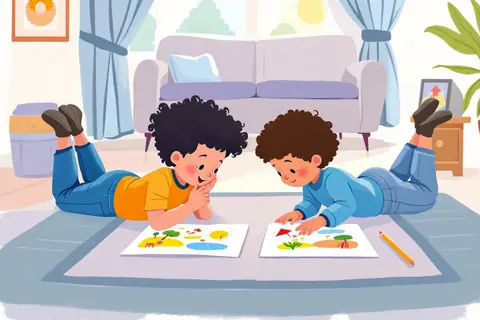
Two pictures sit side by side: a park, a kitchen, a beach or a classroom. They look identical. They are not. Five small things have changed, and your child finds them by tapping. It is one of the calmest games on the site, and it suits a wide range: four-year-olds can find the missing sun with a little help, and a ten-year-old will still lean in to hunt for the one striped sock that is now spotted.
What careful looking does for reading and math
The skill here is visual attention: looking at something properly, part by part, instead of taking in the general shape and moving on. Children who are new to reading often glance at a word, catch the first letter and guess the rest. That is how "house" becomes "horse" and "was" becomes "saw". It is also how b and d get swapped, since the two letters have the same parts in a different arrangement, exactly the kind of thing a spot-the-difference scene trains the eye to notice.
Math has its own tiny details that change everything. A plus sign that is really a minus sign. The 6 that was a 9. A decimal point that turns 25 into 2.5. A child who has practised slowing down and comparing two things carefully is a child who rereads the question. You will not see the connection the first day, but over a season of play you may notice your reader stopping on a word and saying "wait, that's not right", which is the whole point.
Where to look: teaching a search plan
Most children start by scanning wildly, eyes jumping around the picture. They find two differences fast and then get stuck. That is the moment to offer a plan. Here is a short exchange that works well:
Grown-up: "Where have you looked so far?" Child: "Everywhere!" Grown-up: "Let's try the top strip first. Just the sky and the tops of the trees. Same on both sides?" Child: "Same. Oh, no, one bird is missing." Grown-up: "Nice. Now the middle strip."
Top to bottom, left to right, one strip at a time, is also the direction our eyes move across a page of English text, which is a happy coincidence. Some children prefer "objects first": check every person, then every animal, then every thing in the sky. Either plan beats wild scanning. Let your child pick one and stick with it for a round.
Five kinds of difference
It helps older children to know what to hunt for. Most changes fall into one of these:
| Kind of change | Example in a kitchen scene | Reading or math cousin |
|---|---|---|
| Something missing | The spoon is gone from the bowl | A missing letter in a word |
| Something added | An extra apple on the counter | An extra digit in a number |
| Colour changed | The kettle is green, not red | Bold or highlighted words |
| Shape or pattern changed | Striped cloth becomes dotted | b and d, 6 and 9 |
| Position or size changed | The cat is on the left now | A misplaced decimal point |
After a round, ask "which kind was that one?" Sorting the differences makes the next search faster.
Making it easier or harder
Easier
Sit together and cover half of each picture with a piece of paper, so there is less to look at. Tell your child how many differences are in the uncovered half. Give warm and cold clues: "You are close, it is near the swings."
Harder
Ask your child to find all five without tapping, then tap them in one go. Set a gentle personal challenge: "Can you find them in the order top to bottom?" Or turn it around: after the round, look away and ask them to describe one difference from memory. That adds a memory layer, much like the light patterns in Light Up the Tree.
Make your own with two copies of a drawing
This is a lovely rainy-day project, and children are often more proud of the puzzle they make than of the ones they solve.
- Draw a simple scene in pencil: a house, a tree, a sun, a person and a pet are enough.
- Make a copy. Trace it at a window, or ask an older child to redraw it carefully.
- On the second copy, make five changes: erase one thing, add one thing, change one colour, change one pattern and move one small thing.
- Colour both copies in.
- Swap with someone in the family and race to find each other's changes.
Making the changes is the secret lesson. To hide a difference well, a child has to think about what eyes skip over, and that is careful looking from the inside.
Why it calms kids down after school
At 4 p.m. many children are buzzing and drained at the same time. A loud, fast game can tip them over. This one asks for quiet focus with no clock and no losing. The pictures do not move, nobody rushes them, and every find brings a small, satisfying "got it". In our house, a round of spot the difference with a snack has rescued more than one grumpy after-school hour. If your child needs something even gentler, the read-aloud stories in the Story Corner are another good wind-down.
Playing in pairs
Two children, one screen, works well with a simple rule: take turns finding a difference, and the finder has to explain it in a full sentence ("The bucket on the right side is blue instead of yellow") before tapping. That sentence does a lot of work. It slows the hasty player down, gives the quieter one a turn, and practises describing position with words like left, right, above and beside. For siblings of different ages, give the younger one the first two finds and the older one the tricky last three.
What to watch for
Watch the search, not the speed. Does your child use a plan, or still jump around? Do they check both pictures, or stare at one? When they get stuck, do they give up or slow down? A child who learns to say "let me look again, strip by strip" has picked up a habit that will show up later at the bottom of a math worksheet, checking that the 6 really is a 6.