
Home For grown-ups Reading and Writing
Notes for grown-ups
Sight Words at Home: A Calm 10-Minute Routine and Games
By Maud Harcastle9 min read
Sometime in Kindergarten or Grade 1, a list of short words often comes home in a backpack: the, and, was, said, you, they, of. The note says to practise them. Many parents are not sure what "practise" should look like, and the most common answer (a stack of flashcards and a lot of sighing) is not the most useful one.
This piece explains what sight words are, why some of them are easier than they look, how many to work on at once, and a routine that takes about ten minutes and does not make anyone cry.
What sight words are
"Sight words" is used in two slightly different ways, and knowing both helps.
The first meaning is simply high-frequency words: the small words that turn up again and again in everything children read. A handful of them (the, and, a, to, is, in, it, of, you, that) make up a big share of the words on any page of a simple book. If a child has to stop and work out "the" every time it appears, reading a story becomes exhausting. Knowing these words instantly frees up attention for the harder ones.
The second meaning is words that a child reads on sight, without sounding them out. That is the goal for every word eventually, not only the short ones. A fluent adult reads "elephant" on sight. A beginning reader sounds it out the first several times, and then one day it simply becomes known.
So the aim of sight word practice is not to learn a list as a set of pictures. It is to get common words to the point where your child reads them instantly, so the work of reading can go into the rest of the sentence.
Decodable words and tricky words
Here is the part that changes how you practise. Most words on a typical sight word list are not irregular at all. Many can be sounded out with the phonics your child is already learning.
| Word | Can it be sounded out? | What to say to your child |
|---|---|---|
| and | Yes: a, n, d | "Sound it out. You know all of these." |
| it, in, is | Yes | "Short and easy. Say the sounds and blend." |
| can, not, but | Yes | "Three sounds, three letters." |
| the | Partly: th is regular, the e is unusual | "The th you know. The e says 'uh' here." |
| was | Partly: w and s are fine, the a is odd | "The a sounds like 'o' in this word. That's the tricky bit." |
| said | Partly: s and d are fine | "The a and i together say 'eh'. That's the part to remember." |
| of | Mostly tricky: the f sounds like v | "This one is a rule-breaker. Let's learn it by heart." |
| you, they | Partly | "Find the part that follows the rules, then the part that doesn't." |
This matters because a child who thinks every sight word must be memorised as a whole shape can end up with hundreds of separate pictures to remember, and that does not scale. A child who sounds out the regular parts and only memorises the odd bit has far less to carry. For "said", they need to remember one thing: the a and i together say "eh". The s and d take care of themselves.
So when a new word comes home, look at it together and sort it: easy (sounds out completely), mostly easy (one tricky part) or rule-breaker (learn it whole). Most will land in the first two piles.
How many words at a time
Fewer than you think. Three to five new words at a time is plenty for a five or six-year-old, mixed with words they already know. A list of twenty new words in one week tends to blur together, and children start guessing based on the first letter ("was"? "want"? "went"?).
A useful set for one week looks like this:
- 3 new words (for example: said, was, they)
- 5 to 8 known words to mix in, so most practice is a success
- 1 or 2 words from last week that are almost known
When the new words are solid (more on how to tell below), add the next three. Steady beats fast. A child who truly knows twenty words by the end of a term is in a better place than a child who has "done" one hundred and knows half of them.
A 10-minute routine
This is the routine I come back to. It works best at the same time each day, when your child is not starving or exhausted: after a snack, before dinner, or as part of a bedtime wind-down.
- Warm up (1 minute). Read three or four known words from cards. Fast, easy, and a good start.
- Meet the new word (2 minutes). Write it large on a card. Say it, use it in a sentence ("I said hello"), then sound out the regular parts together and point to the tricky part. Underline or circle that part.
- Write it (2 minutes). Your child writes it three times while saying each letter aloud. Then they turn the card over and write it from memory once.
- Play one game (4 minutes). Pick one of the games below, using the new word mixed with known ones.
- Find it in a real book (1 minute). Open any picture book and hunt for the word on one page. Children are always delighted to find "said" in a real story.
Ten minutes, done. If your child is tired, do only steps 1, 2 and 5. A short session that ends well is better than a full one that ends in tears.
For grown-ups: the box below links to a shop for books or learning tools that fit this topic. If you buy through it, Megatfo may earn a small commission at no extra cost to you. The games on this site never show shops or ads to children.
Games that make words stick
You do not need anything special for these. Index cards, a marker and household objects are enough.
Word hunt
Hide word cards around one room (under a cushion, on the fridge, inside a shoe). Your child finds a card, reads it aloud, and brings it back. If they read it correctly, it goes in their pile. Ten cards is a good round. To make it harder, call out a word and they hunt for that specific card.
Flashlight words
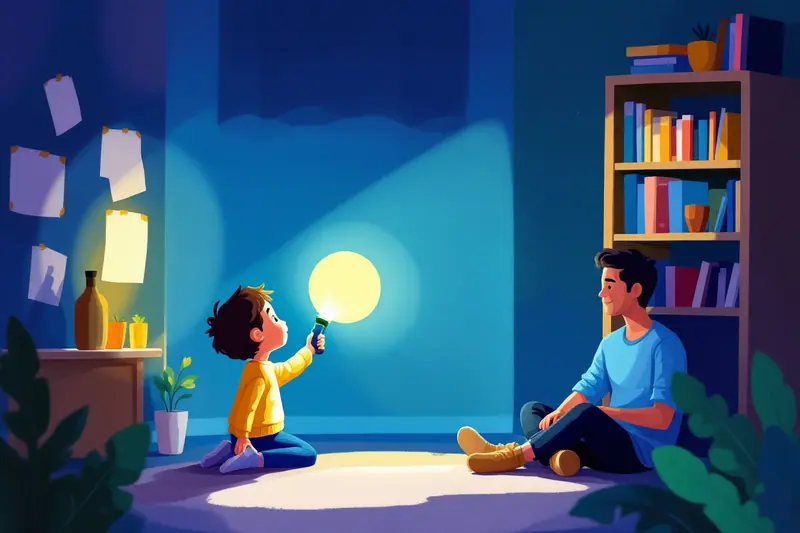
This one is a favourite on dark winter evenings. Tape word cards on a wall or bookshelf, turn off the lights, and give your child a flashlight. They shine it on a card and read it. Then you call out a word and they find it with the light. Something about the dark and the beam makes the same words feel completely new.
Slap
Lay six to eight cards face up on the table. Call out a word. Whoever slaps the right card first keeps it. Let your child win more often than you do, especially early on, and sometimes slap the wrong card on purpose so they can correct you. Children love catching a grown-up making a mistake.
Sentence fill
Write a short sentence with a gap: "The dog ___ hello." Your child picks the right word card from three choices (said, was, they) and places it in the gap. Then they read the whole sentence. This is the bridge between knowing a word on a card and reading it in real text. The Story Bubbles game works in a similar way, with whole sentences built from word bubbles.
Spell it in order
Spelling a word letter by letter is one of the best ways to check it is really known, not just recognised. The Spelling Snake game has a sight word list, and it asks for the letters in order, which is exactly the skill you are looking for.
How to tell when a word is really known
A word is known when your child can do all three of these:
- Read it instantly (in about a second) on a card, without sounding it out.
- Read it instantly inside a sentence in a real book, not only on the card.
- Spell it, out loud or on paper, from memory.
The second test catches many children out. They know "was" on its special card, in its special place in the pile, but in a book it looks different. That is why step 5 of the routine matters.
The third test catches the rest. Some children read "they" perfectly but spell it "thay". That is a sign that the tricky part (the ey) has not quite settled yet. Keep it in the pile.
A simple tracking sheet helps if you want one:
| Word | Reads on card | Reads in a book | Spells it | Known? |
|---|---|---|---|---|
| said | Yes | Yes | Yes | Yes |
| was | Yes | Sometimes | Yes | Almost |
| they | Yes | Yes | No (thay) | Not yet |
Once a word has been "known" for a week, you can stop practising it on its own. It will stay fresh just through reading.
Mistakes that slow things down
Drilling the whole list at once
A list of 200 words is a list for a whole year or more, not a week. Working through it all at once turns practice into a test, and children quickly learn to dread it. Three to five new words at a time is enough.
Treating every word as a rule-breaker
If you tell a child "you just have to remember this one" for "and", you are teaching them that reading is about memorising, when "and" can be sounded out easily. Save "learn it by heart" for the genuinely odd ones like "of".
Only using cards
Words on cards are a start, but children need to see them in books, in sentences and in their own writing before they are really known.
Rushing
It is very tempting to add new words before old ones are solid, especially when a sibling or classmate seems to be further ahead. A child who feels successful will keep going. A child who feels behind will start to avoid reading altogether.
Long sessions
Twenty minutes of flashcards after a long school day helps nobody. Ten minutes, with a game and a laugh, does more.
Questions from grown-ups
The list from school has 100 words on it. Where do I start?
Start with the words you see most often in your child's books, which are usually the first ones on the list. Pick three, sort them into easy, mostly easy and rule-breaker, and begin. If you are unsure of the order, ask the teacher which words the class is working on this week.
My child knows the words on cards but freezes when reading a book. Why?
This is very common. The card is a clear, single word in a familiar place. A book has pictures, other words and a sentence to follow. Spend more time on the sentence fill game and on finding the words in real books, and the gap usually closes within a few weeks.
Should I do sight words or phonics?
Both, and they support each other. Phonics lets your child sound out the regular parts of sight words, and sight words let them read simple books sooner, which gives them more practice with phonics. If your child is struggling with both, talk to the school.
Is it okay to skip a day?
Yes. A few days a week of short, happy practice does more than a strict daily routine that everyone resents. If you miss a day, pick it up the next one.
A small box of word cards on the kitchen counter, with a rubber band around the "known" pile, tends to do more than any chart on the fridge. Children like watching that pile get thicker.
Filed under: Reading and Writing

Maud writes about early reading and writing: phonics, sight words, reading aloud and getting reluctant writers to put a sentence on paper. She reads every story aloud before it goes up.