
Home For grown-ups Classroom Corner
Notes for grown-ups
Math Game Stations in the Classroom: Setup, Rotations and a Sample Block
By Greer Bramwell8 min read
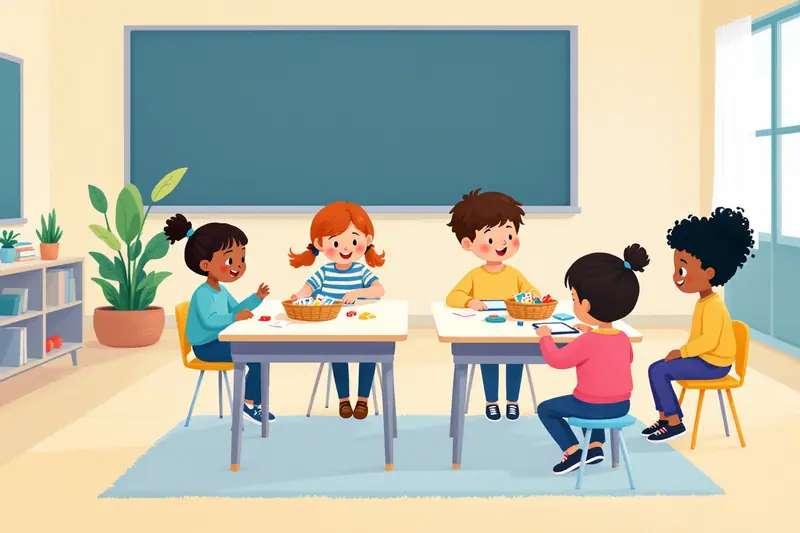
Math game stations look chaotic from the doorway and run like clockwork from the inside, when they are set up well. The goal is simple: small groups rotate through four to six short activities, each one practising a skill the class already understands. The teacher either floats or sits at one station working with a small group. Done badly, stations are 45 minutes of noise and lost dice. Done well, they are the part of the week children ask for.
This is a practical setup guide: how many stations, how to group, how long each rotation should be, how to keep students accountable, and a full sample block you can copy.
How many stations, and what goes in them
Four stations is the easiest place to start. Six is the comfortable maximum for most rooms. More than that and the transitions eat the lesson.
Each station should practise something students already know how to do. Stations are for practice and fluency, not first teaching. A good rule: if a student cannot explain the game's goal in one sentence, the game is not ready to be a station.
A balanced set of five looks like this:
| Station | Activity | Skill | Materials |
|---|---|---|---|
| 1. Card table | Make 10 or a War variation | number bonds, comparing sums | 2 decks with face cards removed |
| 2. Screen station | one learning game on two devices | depends on the game chosen | 2 tablets or laptops, headphones |
| 3. Build it | arrays or fraction strips | multiplication or fractions | counters, paper strips, scissors |
| 4. Dice race | roll, add, record on a grid | addition, subtraction | 4 dice, laminated grids, markers |
| 5. Teacher table | small-group instruction | whatever the group needs next | whiteboard, markers, manipulatives |
The card table is the cheapest station to stock and the hardest to wear out. A full menu of deck games that suit it is in card games that teach math.
For the screen station, choose one game for the whole rotation and set it to the right level before students arrive. Hen Crossing works for addition and subtraction in the younger grades, and Space Bricks for times tables in the older ones. One game, preset, headphones in. Students do not browse.
Grouping
Groups of four are the sweet spot. Three is fine. Five starts to leave someone watching.
There are two common ways to group, and both have a place:
- Mixed groups (different levels together) work well for games with luck in them, like dice and card games. A stronger student can help without the game becoming a lesson.
- Similar-level groups work better when the teacher table is one of the stations, because the teacher can pitch the small-group work to that group's exact next step.
Many classrooms use similar-level groups for the rotation itself, and build differentiation into each station (see below) so no group is stuck on something too easy or too hard. Change groups every few weeks. Fixed groups for a whole term become labels, and children notice.
Assigning roles
Give each group member a role for the rotation. It cuts arguments and makes cleanup automatic.
- Materials keeper: opens the basket, counts items back in.
- Rule checker: settles disputes using the rule card in the basket.
- Recorder: fills in the group line on the exit slip.
- Timekeeper: watches the room timer and starts the cleanup at the one-minute signal.
Rotate the roles each day.
Timing the rotations
Rotation length depends on age and attention, and on how long the games take to get going.
| Grade | Rotation length | Stations per block | Transition time |
|---|---|---|---|
| Kindergarten to Grade 1 | 8 to 10 minutes | 3 or 4 | 2 minutes |
| Grades 2-3 | 10 to 12 minutes | 4 | 1 to 2 minutes |
| Grades 4-6 | 12 to 15 minutes | 4 or 5 | 1 minute |
Not every group needs to visit every station every day. With five stations and a 45-minute block, three rotations a day over two days covers everything with time to spare. That is often calmer than cramming.
Use a visible timer and one consistent signal: a chime, a clap pattern or a raised hand. The signal means "one minute: finish your turn and pack up". A second signal means "move". Practise the move itself before you ever play a game. It feels silly. It saves ten minutes a week.
Teach the games first
This is the step most often skipped, and it is the reason stations fall apart. A game introduced at the station is a game nobody plays properly.
Introduce each new game to the whole class before it becomes a station. A tidy pattern:
- Model it at the front with a volunteer, narrating every move: "I flip two cards, a 6 and a 4. Do they make 10? Yes, I keep them."
- Fishbowl it: one group plays in the middle while everyone else watches and points out what they notice.
- Play it whole class for five minutes, in pairs, on the carpet.
- Only then put it in a station basket.
Each basket gets a rule card: three or four steps, a small picture, and the goal in one sentence. The rule checker reads it aloud before play starts.
Add no more than one new game per week. Most of the stations in any given week should be games students already know.
Accountability: exit slips
Stations need a short record of what each student actually did. Without one, a game can turn into chatting with cards in hand. Exit slips also tell the teacher, in five minutes after school, who needs the teacher table tomorrow.
Keep the slip tiny. A half sheet with:
- Station name (circled from a printed list)
- One problem I solved (written out: "7 + 3 = 10" or "4 × 6 = 24, I used an array")
- One face or a number from 1 to 3: how sure I felt
For the screen station, students write one question the game asked and their answer. For the build station, they draw what they built. That last line, how sure I felt, is the most useful one for planning.
Slips go in a tray by the door at the end. Do not grade them. Read them.
Noise
Game stations are not quiet, and they should not be. The aim is productive noise: game talk at table volume.
Some things that keep it there:
- Agree on a volume level before the first rotation and name it: "table voices, heard at your table, not at the next one."
- Foam or felt mats under dice. Dice on bare tables are louder than any student.
- Space the stations so groups face away from each other.
- Headphones at the screen station, always.
- Use a quiet signal, not a louder voice. A raised hand that spreads around the room works better than calling out over the top.
If the noise climbs anyway, stop the rotation for 30 seconds, reset quietly, and restart. Do not lecture. The pause itself is the message.
Differentiation inside each station
Rather than different stations for different groups, build two or three levels into the same station. Students take the version marked for their group, or choose and the teacher adjusts.
| Station | Level 1 | Level 2 | Level 3 |
|---|---|---|---|
| Card table | Make 10 with cards 1 to 10 | Make 20 with two cards plus one | Make a target number the group draws |
| Dice race | one die, add 2 each roll | two dice, add | two dice, multiply |
| Build it | arrays up to 5 × 5 | arrays to 10 × 10, split into two | fraction strips: find equal fractions |
| Screen | easiest setting | middle setting | mixed or hardest setting |
Colour-code the levels with a dot on each card set or recording sheet. Students learn the system in a day, and no one has to announce who is on which level.
A sample 45-minute block
Here is one block for a Grade 3 class of 24, in six groups of four. Three stations are set up with room for two groups each: the card table, the dice race and the teacher table.
| Time | What happens |
|---|---|
| 0:00 to 0:05 | Whole class on the carpet. Quick warm-up: five mental math questions. Remind the class of one rule (table voices). |
| 0:05 to 0:07 | Groups collect baskets and go to their first station. Roles are on the group card. |
| 0:07 to 0:19 | Rotation 1 (12 minutes). Teacher table: two groups work on regrouping in subtraction with base-ten blocks. |
| 0:19 to 0:21 | One-minute signal, cleanup, move. |
| 0:21 to 0:33 | Rotation 2 (12 minutes). Teacher table: next two groups. |
| 0:33 to 0:35 | Signal, cleanup, move. |
| 0:35 to 0:41 | Rotation 3, short (6 minutes). The last two groups at the teacher table work on a whiteboard review card while the teacher floats and checks exit slips. |
| 0:41 to 0:45 | Cleanup, slips in the tray, back to the carpet. One student from each group shares one problem they solved. |
The two groups who did not reach the teacher table go first next time. That is it. Simple to copy, simple to adjust.
Materials list
For four to six stations and a class of about 24:
- 4 decks of playing cards (face cards out for younger grades)
- 8 to 12 dice, plus felt or foam mats
- a tub of counters (or dried beans, buttons, bottle caps)
- base-ten blocks or homemade ones from paper
- fraction strips (paper, cut and labelled)
- small whiteboards and dry-erase markers
- laminated recording grids
- 2 tablets or laptops with headphones for one screen station
- one basket or tub per station, each with a laminated rule card
- a visible timer and a chime
- a stack of half-sheet exit slips and a tray
Homemade versions of most of these, and which ones are worth buying, are covered in the Books and Tools archive.
Questions from grown-ups
What does the teacher do if there is no teacher table?
Float, with a clipboard. Spend about two minutes at each station, ask one student to explain their last move, and note anything that needs reteaching.
What if a group finishes the game early?
Every basket gets a "keep going" card: play again with the level 2 version, or write a problem for another group to solve.
Can stations work with a single device?
Yes. Make the screen station a pair activity, not a group one. Two students play while two others, at the same station, do the paper version of the same skill. Swap halfway.
How often should stations run?
Two or three times a week is common. Daily works too, if the games change often enough that students are still practising, not just playing on autopilot.
On Monday, pick one game the class already knows, put it in a basket with a rule card, and run a single 10-minute rotation with four groups. Add the second station on Wednesday.
Filed under: Classroom Corner

Greer writes for teachers of primary grades: game stations, brain breaks, quick checks for understanding and classroom routines that survive a Friday afternoon.