
Home For grown-ups Learning Through Play
Notes for grown-ups
Card Games That Teach Math With an Ordinary Deck of Cards
By Adaeze Morrow8 min read
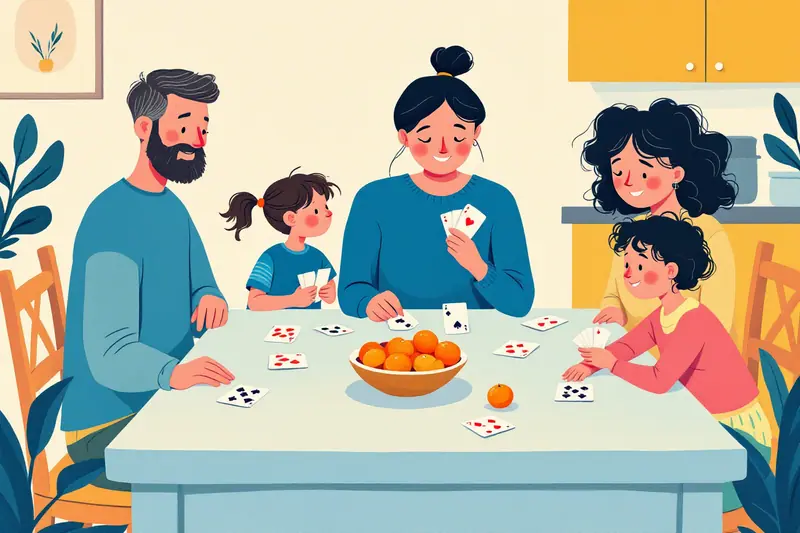
If you own one deck of cards, you own a math kit. It fits in a coat pocket, survives being sat on, works in a power outage and costs less than a sandwich. Better still, children do not file a card game under "homework". They file it under "beating a grown-up", which is the most motivating category there is.
What follows are seven games I keep coming back to, from the simplest pairing game for a five-year-old to a place-value game that makes a Grade 5 child sweat a little. Each one has a setup, rules written step by step, and notes on making it work when a six-year-old and a ten-year-old both want to play.
Setting up your deck
Most of these games use a trimmed deck. Before you start:
- Aces are 1. Say it out loud every time for the first week.
- Take out the face cards (jacks, queens, kings) for the youngest players. For older ones you can keep them and make them worth 10, or 0, depending on the game.
- Jokers can be wild, or can be zero. Zero is surprisingly useful in place-value games.
A deck with face cards removed leaves 40 cards: four of each number from 1 to 10. That is the deck I mean below unless a game says otherwise.
Which game for which child
| Game | Rough ages | Main skill | Players | Time |
|---|---|---|---|---|
| Make 10 | 5 to 7 | Number bonds to 10 | 1 to 3 | 10 min |
| War, plus variations | 5 to 11 | Comparing, adding, multiplying | 2 | 10 to 15 min |
| Go Fish for 10 | 5 to 8 | Bonds to 10, asking in full sentences | 2 to 4 | 15 min |
| Twenty-one for addition | 7 to 10 | Adding on, estimating | 2 to 4 | 10 min |
| Salute | 7 to 11 | Missing addends, missing factors | 3 | 10 min |
| Close to 100 | 8 to 11 | Place value, two-digit addition | 2 to 4 | 15 min |
| Fraction War | 9 to 12 | Comparing fractions | 2 | 10 min |
Ages are guesses, not rules. Plenty of seven-year-olds love Salute, and plenty of ten-year-olds still ask for Make 10 when they are tired.
Make 10
This is the game I would teach first. It is a solitaire-style pairing game, and it builds the bonds that sit under almost all mental arithmetic. If you want the background on why those bonds matter so much, our piece on number bonds to 10 and 20 explains it well.
- Shuffle the 40-card deck. Lay out 12 cards face up in three rows of four.
- Look for any two cards that add to 10: a 3 and a 7, a 6 and a 4, a 10 on its own counts too.
- Pick up each pair you find and put it in your pile, saying the sum out loud ("three and seven make ten").
- Fill the gaps from the deck.
- Keep going until the deck runs out or no pairs are left.
For two or three players, take turns. On your turn you may take one pair. If you cannot find one, you add a card from the deck and play passes.
Easier: lay out only 8 cards, and let the child use a row of ten buttons to check. Harder: play Make 15 with any number of cards (an 8, a 4 and a 3 is legal), or Make 20 with the face cards counted as 10.
War, and why the variations matter
Classic War is pure comparing: each player flips a card, bigger card wins both. That is useful for a four- or five-year-old learning that 8 is more than 6, but it runs out of steam fast. The fix is to change what gets compared.
| Variation | Each player flips | Compare | Example |
|---|---|---|---|
| Sums War | 2 cards | The sum | 7 + 5 = 12 beats 4 + 6 = 10 |
| Difference War | 2 cards | The difference | 9 and 2 (7) beats 6 and 5 (1) |
| Make 10 War | 1 card | What it needs to make 10 | A 2 (needs 8) beats a 7 (needs 3) |
| Times War | 2 cards | The product | 6 x 4 = 24 beats 5 x 4 = 20 |
| Double War | 1 card | Its double | A 7 (14) beats a 6 (12) |
The rule I add to every version: the winner must say the number sentence before taking the cards. No sentence, no cards. It is the difference between flipping and practising. The Math War game on this site runs several of these modes on screen, which is handy when the deck has gone missing under the couch.
Go Fish for 10
Same idea as the classic, but instead of collecting matching numbers, you collect pairs that make 10.
- Deal 5 cards to each player (7 for two players). The rest is the pond, face down.
- Any pairs that make 10 in your hand go face up in front of you straight away.
- On your turn, choose a card in your hand and ask another player for its partner. Holding a 4, you ask: "Do you have a 6?"
- If they do, they hand it over and you lay down the pair. You go again.
- If not, they say "Go fish" and you draw from the pond.
- When the pond is empty and nobody can play, the player with the most pairs wins.
The asking is the math. To ask for a 6, the child has to know what goes with 4. Little ones can keep a cheat strip on the table: 1 and 9, 2 and 8, 3 and 7, 4 and 6, 5 and 5. Tens make a pair on their own.
Twenty-one for addition
This one has nothing to do with betting in our house. It is a running-total game, and the thinking is all about adding on and judging risk.
- Face cards are 10, aces are 1. Each player gets two cards face up.
- Add your total out loud.
- On your turn, you may take another card or stop.
- Going over 21 means you are out for the round.
- When everyone has stopped, the total closest to 21 wins.
The useful conversation is the one about stopping: "You have 17. How many cards in the deck would push you over?" Anything worth 5 or more does. That is subtraction and a little probability in one breath.
Salute
Salute needs three people: two players and a caller. It is wonderful for missing-number thinking.
- The two players each take a card from the top of the deck without looking and hold it against their forehead, facing out.
- The caller can see both cards and says the sum: "Twelve!"
- Each player can see the other's card but not their own. If you see a 5, and the sum is 12, your card must be 7.
- First to say their own card correctly wins both cards.
- Rotate the caller every few rounds.
Older players can switch to the product: the caller says "Twenty-four," you see a 6, you need a 4. That is division in disguise, and it gets loud.
Close to 100
This is the place-value game, and it shows very clearly whether a child understands that the 3 in 37 means 30.
- Use cards 0 to 9 (jokers or queens as 0, take out the tens and other face cards).
- Each player gets six cards.
- Using four of your six cards, make two two-digit numbers whose sum is as close to 100 as possible. With 2, 6, 7, 3, 9, 1 you might make 62 + 37 = 99.
- Your score is how far you are from 100. Ninety-nine scores 1.
- Discard the four cards you used, draw four new ones and play again. Lowest total after five rounds wins.
The sweet spot is watching a child realize the tens digits should add to about 9, and the ones digits to about 10. That is a real insight, and it came from shuffling, not a worksheet.
Fraction War
For children who have met fractions at school, around Grade 4 or 5 in many places.
- Each player flips two cards and makes a fraction with the smaller number on top. A 3 and a 4 makes 3/4.
- The larger fraction wins. 3/4 beats 1/2.
- If the fractions are equal (2/4 and 1/2), it is a war: flip again.
Arguments will happen. 2/3 against 3/5 is a proper debate. Keep a sheet of paper strips folded into halves, thirds, quarters and fifths nearby to settle them, and if you want the ideas behind it, our article on fractions, decimals and percentages has benchmark equivalents worth knowing.
Playing with mixed ages
The trouble with family card games is that the ten-year-old wins and the six-year-old quits, or the grown-ups play gently and the ten-year-old is bored. A few fixes that work:
- Same game, different jobs. In Sums War, the younger child compares single cards while the older one compares sums. Both flip at the same time; each wins against their own rule.
- Handicap by deck. Give the younger player only the cards 1 to 5 in Make 10 War. The numbers are smaller but the thinking is the same.
- Make the older child the caller. In Salute, a ten-year-old caller gets practice from checking everyone else's answers.
- Teams. Pair a big kid with a little kid against two grown-ups. The big kid explains, which is its own kind of practice.
- Score something other than winning. Count the sentences said out loud, as a family total. Everyone contributes.
A week of card games
If you want a gentle plan rather than a pile of options, try ten minutes after dinner for one week:
| Day | Game | Watch for |
|---|---|---|
| Monday | Make 10 | Pairs said out loud |
| Tuesday | Sums War | Counting on from the bigger card |
| Wednesday | Go Fish for 10 | Asking for the right partner |
| Thursday | Rest day | |
| Friday | Twenty-one | Deciding when to stop |
| Saturday | Salute or Close to 100 | Explaining the missing number |
| Sunday | Child's choice | Which one they pick tells you a lot |
By Sunday you will know which skill is solid and which needs a second week. Keep the deck in the fruit bowl so it is always the easiest thing to reach for, and expect the six-year-old to ask for "the ten game" before you have finished clearing the plates.
Filed under: Learning Through Play

Adaeze writes about learning through play: card games, puzzles, memory games and the kind of screen time that leaves kids thinking. She keeps a shelf of games that cost nothing to make.