Home For grown-ups Classroom Corner
Notes for grown-ups
Five-Minute Brain Breaks That Teach: 15 Quick Games for Any Classroom
By Greer Bramwell8 min read
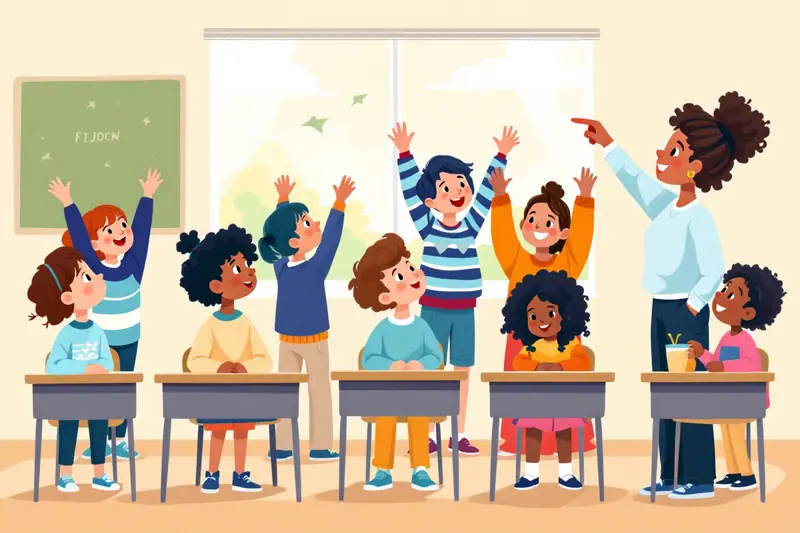
A brain break is a short pause in the day when children get up, move or laugh, and then come back to work with more attention than they left with. The usual versions are pure movement: stretches, dance songs, a lap of the room. Those are fine. But with almost no extra effort, a brain break can also practise a skill. Children still get to move. You still get them back on task. And the class has counted by sevens or spelled ten words along the way.
This guide gives you the ground rules first, then the main types with exact scripts, and a list of 15 to keep on a card by the board.
When to use a brain break
The best moments are predictable ones:
- After a long sit. Around 20 to 30 minutes of seated work is when most primary classes start to fidget, earlier for the youngest.
- Between subjects. A two-minute break between reading and math clears the old task.
- Before something that needs focus. A quick movement break before a test or a read-aloud settles bodies.
- When the room tips. Rising noise, kids lying on desks, three pencils dropped in one minute. That is the cue.
Avoid them right before lunch or the bell, when children are already halfway out the door. And avoid using a brain break as a reward to be earned or lost. It works best as a normal part of the day.
Keeping control
The fear with brain breaks is that you will lose the room and not get it back. You will not, if the routine is tight.
- Same start signal every time. "Brain break: stand behind your chair." Children learn that it means movement in a fixed spot, not wandering.
- Your own space. Each child stays in the space around their chair. Arms out to check: if you can touch someone, step back.
- Clear end signal. A countdown from five, said softer and softer, ending with "sit and breathe". Then three slow breaths together.
- Short. Five minutes at most. Three is often better. End while children still want more.
- Practise the ending first. The first time you run a break, practise the end signal twice before playing. It feels silly. It is the whole trick.
If a break gets too wild, end it early and calmly. No speech. Try again tomorrow with a quieter one.
Movement counting games
These work for skip counting, times tables and number sense, and they need nothing but bodies.
Count and move
The class counts aloud by a chosen step. On every number, everyone does a movement. Change movement every ten numbers.
A sample script for counting by 3s:
Grown-up: "Counting by threes. Jumping jacks. Go!" Class: "Three, six, nine, twelve, fifteen, eighteen, twenty-one, twenty-four, twenty-seven, thirty!" Grown-up: "Switch to arm circles. Keep going from thirty." Class: "Thirty-three, thirty-six..."
For younger children, count by 1s or 2s and add a big movement on every multiple of 5: a stomp, a clap above the head.
Buzz
Count around the room, one number per child. Any multiple of the chosen number gets "buzz" and a squat instead of the number. Counting with a 4 buzz: "one, two, three, BUZZ, five, six, seven, BUZZ". A child who says the number instead does a quick spin and the count keeps going. Nobody is out.
Simon says geometry
Children make shapes and angles with their arms, hands and bodies.
- "Simon says make a right angle with your arms." (one arm straight up, one straight out)
- "Simon says make an acute angle." (arms close together above the head)
- "Simon says make an obtuse angle."
- "Simon says show me parallel lines." (both arms straight up)
- "Make a triangle with a partner." (no Simon: anyone who moves sits for one round, then rejoins)
The vocabulary sticks because the body remembers it. If your class has been working with polygons, the Shape Strategy game uses the same words on screen.
Word chains
Standing in a circle or beside their chairs, children pass a word along. The next word must start with the last letter of the one before. Each child does a hop as they say their word.
| Turn | Word | Next letter |
|---|---|---|
| 1 | elephant | t |
| 2 | tiger | r |
| 3 | rabbit | t |
| 4 | turtle | e |
| 5 | eagle | e |
Narrow the category for older students: only nouns, only adjectives, only words with two syllables. For younger students, swap to rhyme chains: cat, hat, bat, mat. Spelling the word aloud as well as saying it doubles the practice.
Quick estimation
Hold up a clear jar of something (buttons, pasta, paper clips) or point at something in the room. Children stand on the side of the room for "more than" or "less than" a number you name, then guess the exact amount with fingers or on a whiteboard.
Good estimation prompts:
- How many steps from the door to the window?
- How many pencils are in this cup?
- How many seconds can we balance on one foot as a class?
- How tall is the door, in metres?
Then check. Measure the door with a metre stick. Count the steps together. The checking is the lesson.
Mystery number
You think of a number. Children ask yes-or-no questions using math words, and act out the answer: arms up for yes, arms down for no.
Child: "Is it even?" Grown-up: "Yes." (arms up) Child: "Is it more than 50?" Grown-up: "No." (arms down) Child: "Is it a multiple of 10?" Grown-up: "No." Child: "Is it in the 3 times table?" Grown-up: "Yes."
Children start to ask smarter questions after a few rounds, which is the point. Older students can be the one who holds the number.
French action songs
French songs with actions are a natural brain break, especially in French immersion classes or for families learning together. Pick a short song about body parts or movements and sing it while touching each part. Words like la tête (the head), les épaules (the shoulders), les genoux (the knees) and les pieds (the feet) are good to start with. Sing it slowly first, then faster.
An action command game in French works too. Call out saute (jump), tourne (turn), assieds-toi (sit down) and lève-toi (stand up), and let the class follow. For more first words worth knowing, see the first 100 French words for kids.
Fifteen brain breaks, with skill tags
Keep this list on a card near the board. Pick one when the room needs it.
| # | Brain break | Skill | Time |
|---|---|---|---|
| 1 | Count and move (by 2s, 5s, 10s) | skip counting | 2 to 3 min |
| 2 | Buzz with a multiple | times tables | 3 to 4 min |
| 3 | Number bonds jump: I say 7, you jump the partner to 10 | number bonds | 2 min |
| 4 | Simon says angles | geometry | 3 min |
| 5 | Partner shapes with bodies | geometry | 3 min |
| 6 | Word chain | spelling, vocabulary | 4 min |
| 7 | Rhyme chain | phonics | 3 min |
| 8 | Spell and stretch: one letter per stretch | spelling | 3 min |
| 9 | Estimation jar | estimation | 4 min |
| 10 | Steps across the room | measurement | 4 min |
| 11 | Mystery number | number properties | 4 min |
| 12 | Odd or even: stand for even, sit for odd | number sense | 2 min |
| 13 | French body song | French vocabulary | 3 min |
| 14 | French action commands | French listening | 3 min |
| 15 | Freeze and spot: freeze, then name three things in the room that are a given shape | shapes, attention | 3 min |
Number bonds jump (number 3) is a quick win. The grown-up calls a number from 1 to 9 and the class jumps the number that makes 10. Call 7, they jump 3 times. It builds the same fact the card game in number bonds to ten is built on.
A week of brain breaks
Variety keeps breaks fresh, but too much novelty means children spend the break learning rules. A good rhythm is one new break per week, mixed with old favourites. Here is a sample week with two breaks a day, one mid-morning and one mid-afternoon:
| Day | Mid-morning | Mid-afternoon |
|---|---|---|
| Monday | Count and move by 5s | Word chain (animals) |
| Tuesday | Simon says angles | Odd or even |
| Wednesday | Buzz with 3 | French action commands |
| Thursday | Estimation jar (new jar) | Rhyme chain |
| Friday | Mystery number | Class choice from the card |
Friday's class choice is popular and costs nothing. Let a different child pick each week. If you already run game stations, a brain break slots neatly into the transition between rotations; the setup in math game stations in the classroom leaves room for one.
Keep a tally on the card of which breaks get the most energy and which fall flat. After a month, you will have six or seven reliable ones and a clear sense of what your class needs at 10:30 on a grey Tuesday in November.
Questions from grown-ups
Do brain breaks work at home too?
Yes. They fit homework time well. After 15 minutes of homework, a two-minute word chain or count-and-move resets attention.
What if some children will not join in?
Let them do a seated version: counting on fingers, making angles with two pencils. Most join the standing version within a few days.
Can I use a screen for brain breaks?
Sometimes, but movement breaks work best without one. A short, active game is better than a video.
Tomorrow morning, after the first block of work, stand the class behind their chairs and count by fives to 100 with a stomp on every ten. It takes 90 seconds.
Filed under: Classroom Corner, Learning Through Play

Greer writes for teachers of primary grades: game stations, brain breaks, quick checks for understanding and classroom routines that survive a Friday afternoon.