Home For grown-ups Math at Home
Notes for grown-ups
Number Bonds to 10 and 20: A Parent's Guide with a Practice Plan
By Tobias Quarrie8 min read
If I could choose only one piece of early arithmetic for a child to know cold, it would be the pairs of numbers that make ten. Not the times tables, not long addition, not counting to a hundred. Just this: 1 and 9, 2 and 8, 3 and 7, 4 and 6, 5 and 5. These pairs, and the pairs that make twenty, sit underneath almost every mental calculation children will do in primary school. A child who knows them instantly finds addition and subtraction much easier. A child who has to count for them every time finds everything slower.
This guide explains what number bonds are, why they matter so much, the two simple tools that help most, and a two-week plan you can use at home in about ten minutes a day.
What a number bond is
A number bond is just a whole split into two parts. Ten can be split into 7 and 3. Ten can be split into 6 and 4. The same whole, different parts.
Children often meet number bonds drawn as a little diagram: a circle at the top with the whole (10), and two circles below it with the parts (7 and 3), joined by lines. The diagram is helpful because it shows that addition and subtraction are the same relationship seen from different sides. From one bond, a child gets four facts:
| The bond | The four facts it gives |
|---|---|
| 10 is 7 and 3 | 7 + 3 = 10, 3 + 7 = 10, 10 - 7 = 3, 10 - 3 = 7 |
| 10 is 6 and 4 | 6 + 4 = 10, 4 + 6 = 10, 10 - 6 = 4, 10 - 4 = 6 |
| 20 is 13 and 7 | 13 + 7 = 20, 7 + 13 = 20, 20 - 13 = 7, 20 - 7 = 13 |
That is the economy of number bonds. Children are not learning a hundred separate facts. They are learning a few relationships, each one doing the work of four.
Why bonds are the root of mental arithmetic
Here is a small example. Ask a Grade 1 child for 8 + 5. A child who does not know their bonds counts on: "eight, nine, ten, eleven, twelve, thirteen." Five steps, and plenty of chances to slip.
A child who knows that 8 needs 2 to make 10 does it differently: "Eight and two is ten. Five is two and three. Ten and three, thirteen." That is called bridging through ten, and it works for every one of these facts. 9 + 6 is 10 + 5. 7 + 8 is 10 + 5. 6 + 7 is 10 + 3.
Bonds help just as much with subtraction. For 13 - 5, a child can go back to ten first (13 - 3 = 10), then take the remaining 2 (10 - 2 = 8). Or they can count up: from 5 to 10 is 5, from 10 to 13 is 3, so the difference is 8. Both routes run through ten, and both depend on knowing the bonds.
Later, the same thinking scales up. 48 + 7 is "48 and 2 is 50, and 5 more is 55." 63 - 9 is "63 take 3 is 60, take 6 more is 54." Bonds to ten become bonds to the next multiple of ten, and then bonds to 100 (65 and 35, 80 and 20). A child who has the small bonds solidly finds those bigger ones far less scary.
Two tools that make bonds visible
The ten frame
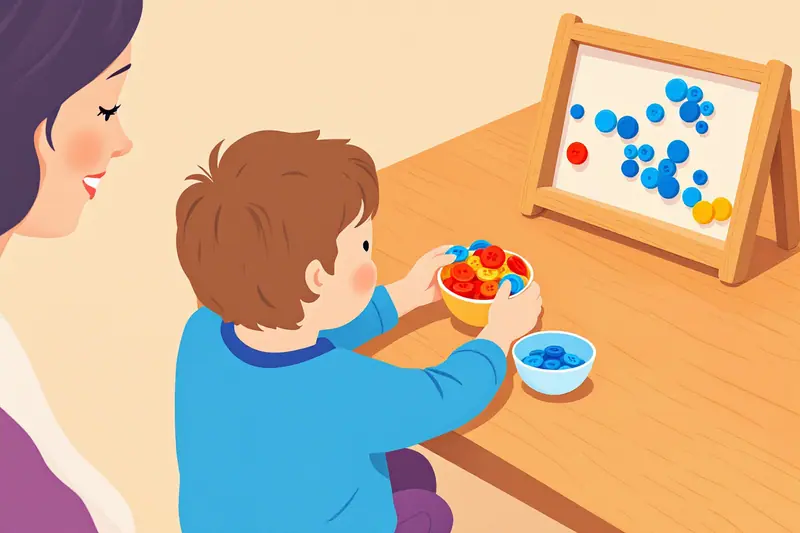
A ten frame is a rectangle of two rows with five boxes in each row. You can draw one on paper in a few seconds. Put counters (dried beans, buttons, cereal) in the boxes, filling the top row first.
The beauty of the ten frame is that children can see an amount and its partner at a glance. Seven counters leave three empty boxes. Nobody needs to count the gaps: you can see a full top row and two more, and three empty spots. After a while children stop counting the counters too, and just recognise the shape of seven.
A second ten frame next to the first gives you numbers up to 20. Fill one frame completely and put three in the other, and 13 looks like "a ten and three."
The bead rack
A bead rack (sometimes called by its Dutch name, rekenrek) is a frame with two rows of ten beads each. In each row, five beads are one colour and five are another. Children slide beads from right to left to show numbers.
The colour change at five is the clever part. A child showing 8 slides one full block of five and three more, and can see that two beads are left in the row. Because the rows are ten long, the bonds to ten are always right there.
You can make one with two pipe cleaners and twenty beads, or with a shoelace and pasta tubes painted in two colours. A string of ten beads, five of each colour, is enough to start with.
Fingers are fine
Some parents worry when children use their fingers. Please do not. Fingers are a ten frame that never gets lost. Hold up seven fingers and the three folded ones are the partner. That is a number bond, on a child's own hands.
What you want, over time, is for children to need their fingers less, not to be told off for using them. If a child always counts each finger one at a time, you can nudge them toward seeing groups: "Show me five on one hand without counting. Now show me seven." Most children quickly learn that a whole hand is five and stop counting it.
Games that practise bonds
Games beat worksheets for this, because the same small facts come up again and again without the child feeling drilled.
- Hidden beans. Put ten beans on the table. Your child closes their eyes while you hide some under a cup. They count the beans left and tell you how many are hiding. Swap roles.
- Make 10 with cards. Use an ordinary deck with the face cards removed and aces as 1. Lay out twelve cards face up. Take any pair that makes ten (a 3 and a 7, a 4 and a 6). Refill the gaps from the deck. A 10 on its own counts as a "ten and nothing" and can be taken by itself.
- Make 10 War. Each player flips a card and says what it needs to make ten. The bigger missing part wins the round. The Math War card game has this as its first level, with sums to 20 when your child is ready.
- Hen Crossing. The Hen Crossing game asks for sums and differences within 10 and 20, and shows a number line hint that bridges through ten when a child gets stuck.
- Clap and finish. You clap a number up to ten, your child claps the rest. You clap four, they clap six.
A two-week practice plan
Ten minutes a day, at any time that suits your family. The aim is not to finish the plan quickly. If a step feels shaky, stay on it for an extra day or two.
| Day | Focus | Activity (about 10 minutes) |
|---|---|---|
| 1 | Seeing five | Show amounts to 5 on one hand and on a ten frame without counting |
| 2 | Seeing ten | Fill a ten frame with beans; name how many are empty |
| 3 | Bonds to 10: 5 and 5, 4 and 6 | Hidden beans game with ten beans |
| 4 | Bonds to 10: 3 and 7, 2 and 8 | Hidden beans, then clap and finish |
| 5 | Bonds to 10: 1 and 9, 10 and 0 | Make 10 with cards (12 cards face up) |
| 6 | All bonds to 10 | Make 10 War, five rounds |
| 7 | Rest or free play | Any game your child picks from the week |
| 8 | Teen numbers as ten and some more | Two ten frames: show 13, 16, 19 |
| 9 | Bonds to 20 using bonds to 10 | 13 and 7, 16 and 4: find the partner using the second frame |
| 10 | Bridging through ten in addition | 8 + 5, 9 + 4, 7 + 6 on two frames, then out loud |
| 11 | Bridging through ten in subtraction | 13 - 5, 14 - 6: back to ten first |
| 12 | Mixed sums and differences to 20 | Hen Crossing or sums with two cards |
| 13 | Speed check, kindly | Ten bonds to 10, called out; note which ones still need a count |
| 14 | Celebrate and repeat the weak ones | Play the favourite game, slipping in the slow facts |
On day 13, do not time it. Just notice which bonds come instantly and which still need a pause. In my experience 3 and 7 and 4 and 6 are often the slowest. That is useful information. Spend a few extra days on those pairs before moving on.
What to watch for
- Counting all instead of counting on. If a child counts both groups from one, show them how to start at the bigger number.
- Slips by one when counting back. In 12 - 4, a child counting "twelve, eleven, ten, nine" lands one short. Draw the jumps on a number line to show that each step is a space, not a number.
- Knowing 7 + 3 but not 3 + 7. Turn the ten frame around, or swap the hands. Same amount.
- Boredom. If the same game has gone stale, change the material. Beans become cars, cards become dice, the table becomes the stairs.
Bonds carry on paying off for years. When fractions and decimals come along, the same "how much more to make a whole" thinking reappears: 0.7 needs 0.3 to make 1, and 3/4 needs 1/4. If you want to read ahead, the guide to fractions, decimals and percentages picks up that thread. For now, count out ten beans, slip a cup over some of them, and ask how many are hiding.
Filed under: Math at Home

Tobias writes about number sense, fractions and the small daily habits that make primary math feel less like a wall of facts. He tests every game idea at a kitchen table first.