Home For grown-ups Books and Tools
Notes for grown-ups
Math Manipulatives to Make or Buy: What Each One Teaches at Home
By Tobias Quarrie9 min read
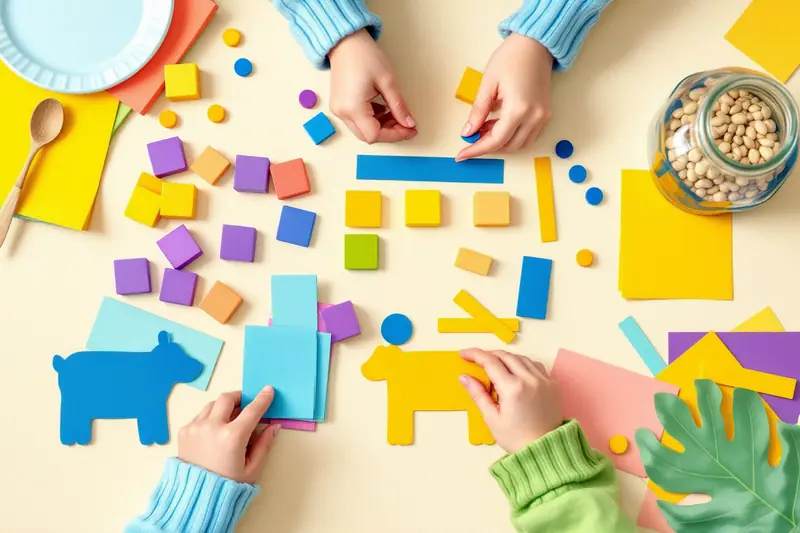
A manipulative is anything a child can hold and move to see a number idea: a bean, a cube, a strip of paper folded into quarters. They matter because most early math is about quantity, and quantity is easier to believe when you can push it around the table. A child who has made 7 with seven beans, then split them into 5 and 2, has something to picture later when the same sum appears on a worksheet.
You do not need a classroom cupboard. Most of what follows can be made from an egg carton, a sheet of card and a bag of dried beans, and the things worth buying are few and cheap. Here is what each tool teaches, how to make it, and when it earns its spot on the shelf.
Counters: the first tool and the one you use longest
Counters are just small, identical objects: dried beans, buttons, pasta shells, plastic chips. Young children use them for counting one to one (touching each object once and saying one number). Older children use them for grouping: 4 groups of 3 for multiplication, 12 shared into 3 piles for division.
To make one: use a cup of dried kidney beans. Spray-paint one side of 40 lima beans and you have two-colour counters, which are handy for showing 6 + 4 as six of one colour and four of the other. Keep them away from toddlers; beans and buttons are a choking risk under age 3.
If you buy: a set of 100 two-sided plastic counters costs very little and lasts for years. Worth it if beans keep rolling under the fridge.
Ten frames: seeing 10 without counting
A ten frame is a 2 by 5 grid. Put counters in it and a child can see "7" as "one full row of 5 and 2 more," or "3 short of 10." That second way of seeing is the heart of number bonds to 10, which carry almost all later mental arithmetic.
To make one: cut two cups off a standard egg carton of 12 and you have a ten frame. Or draw a 2 by 5 grid on card, each square about 4 cm. Draw two side by side for a double ten frame, which takes you to 20.
If you buy: there is no need. A drawn one works as well as anything sold.
A quick game: flash a ten frame with some counters for two seconds, cover it, and ask "How many? How many more to make 10?" Children get fast at this within a week.
Rekenrek: a bead frame that thinks in fives
A rekenrek is a small frame with two rods of 10 beads, each rod split into 5 red and 5 white. Children slide beads across in one push rather than counting them one by one, which nudges them away from counting by ones and toward seeing 5 and 10 as chunks. Showing 8 is "one red five and three white."
To make one: take a strip of stiff cardboard about 30 cm long, two pipe cleaners or lengths of string stretched across, and 20 pony beads (10 red, 10 white) threaded 5 and 5 on each. Tape the ends well.
If you buy: it is worth it for ages 4 to 7 if you want something sturdy, since homemade versions loosen. It is a small purchase.
Base-ten blocks: what "tens" and "hundreds" actually are
Base-ten blocks come in four sizes: a small cube (1), a rod of 10 cubes (10), a flat of 100 cubes, and a big block of 1,000. They make place value physical. A child who builds 243 with 2 flats, 4 rods and 3 cubes can see that the 2 is worth far more than the 3, even though 3 is the bigger digit.
They are also the clearest way to show regrouping. To take 8 from 32, you have to break one rod into 10 loose cubes first. The words "borrowing" and "carrying" stop being magic tricks.
To make one: use 1 cm grid paper. Cut out single squares, strips of 10 and squares of 100. Paper versions are flat but they work. Bundles of 10 craft sticks held with an elastic band are another good stand-in: loose sticks are ones, bundles are tens, and a bundle of 10 bundles is a hundred.
If you buy: this is the one I would buy for Grades 1 to 4. A small home set (100 cubes, 30 rods, 10 flats, 1 cube of 1,000) is enough. Cubes are fiddly to make, and the solid weight of a flat in the hand does something paper cannot.
Fraction strips and circles: same whole, different pieces
Fraction strips are paper bars of equal length, each cut into a different number of equal parts: one whole, halves, thirds, quarters, sixths, eighths, twelfths. Line them up and a child can see that two quarters cover exactly one half, and that one third is longer than one quarter even though 4 is bigger than 3. That last surprise trips up a lot of Grade 3 and 4 children.
Fraction circles do the same with pie shapes. Circles are better for "how much of the whole is left"; strips are better for comparing and adding, because they line up.
To make one: cut seven strips of coloured card, each 24 cm long and 3 cm wide. A 24 cm strip divides cleanly: halves at 12 cm, thirds at 8 cm, quarters at 6 cm, sixths at 4 cm, eighths at 3 cm, twelfths at 2 cm. Rule the lines, label each piece on the back only, and cut. Use a different colour for each strip so pieces sort themselves.
If you buy: it is optional. A sturdy set is nice, but the homemade 24 cm version is genuinely as good. Once strips feel easy, the three names for one amount article shows how to carry the same picture into decimals and percentages.
Geoboards: shapes you can stretch
A geoboard is a square board with a grid of pegs, usually 5 by 5. Children stretch elastic bands over the pegs to make shapes. It is excellent for geometry vocabulary (sides, corners, right angles), for symmetry, and later for area and perimeter by counting squares.
To make one: take a square of thick foam board or soft wood about 20 cm across, with 25 push pins or short nails in a 5 by 5 grid, 4 cm apart. Push pins should only be used with children past the putting-things-in-mouths stage, and with you at the table.
If you buy: a plastic one is cheap, safe and silent. Worth it for ages 5 to 9 if you like shape work. Our Shape Strategy game pairs well with it: build a polygon on the board, then find it in the game.
Pattern blocks: angles, fractions and good old play
Pattern blocks are flat shapes in a fixed set: yellow hexagon, red trapezoid, blue rhombus, green triangle, orange square and a thin tan rhombus. They are sized so that 2 trapezoids make a hexagon, 3 rhombuses make a hexagon and 6 triangles make a hexagon. That makes them a second fraction model (a triangle is one sixth of the hexagon) as well as a pattern and symmetry tool.
To make one: trace and cut from card. The sizes have to be accurate for the fitting to work, so measure with a ruler: every side is the same length (2.5 cm is standard) except the long base of the trapezoid, which is double.
If you buy: yes, if you have a child who likes building. The wooden or plastic ones get used for free play far beyond math time, which is the best sign of a good tool.
Dice and cards: the cheapest kit of all
A deck of cards with the face cards removed gives you 40 number cards from ace (1) to 10. Two dice give you random numbers to 12. Between them you can play dozens of addition, subtraction and multiplication games, and most of them are in our article on card games that teach math.
If you buy: get a few extra dice: ordinary 6-sided ones, plus 10-sided and 12-sided ones for older children. Foam dice make less noise at 7 a.m.
For grown-ups: the box below links to a shop for books or learning tools that fit this topic. If you buy through it, Megatfo may earn a small commission at no extra cost to you. The games on this site never show shops or ads to children.
Which tool, which grade
| Tool | Best ages | Main ideas | Make or buy |
|---|---|---|---|
| Counters | 3-10 | counting, grouping, sharing | make (beans) |
| Ten frame | 4-7 | seeing 5 and 10, bonds to 10 | make |
| Rekenrek | 4-7 | chunks of 5 and 10, adding within 20 | either |
| Base-ten blocks | 6-10 | place value, regrouping | buy |
| Fraction strips | 7-11 | equal parts, comparing, equivalence | make |
| Fraction circles | 7-10 | parts of a whole | either |
| Geoboard | 5-10 | shapes, symmetry, area | either |
| Pattern blocks | 4-10 | shapes, angles, fractions of a hexagon | buy |
| Cards and dice | 4-12 | facts, games, probability | buy (cheap) |
Grades are rough. Many provinces and states introduce place value to 100 around Grade 1 and simple fractions around Grade 2 or 3, but children vary, and a 9-year-old who still reaches for counters is not behind. They are using a sensible tool.
A worked example: one bag of beans, three ages
To show how far one manipulative stretches, here is the same cup of beans at three ages.
At 5: "Put 7 beans on the ten frame. How many empty spaces?" (3.) "So 7 and 3 make?" (10.)
At 7: "Make 3 piles of 4. How many altogether?" Count the piles, then count by fours: 4, 8, 12. Then write it: 3 × 4 = 12.
At 9: "Share 26 beans fairly among 4 people." Each gets 6, and 2 are left over. Ask what you could do with the 2. Snap them in half? Then each person gets 6 and a half. That leftover is the doorway to remainders and fractions.
Storage that actually works
The real reason manipulatives go unused is that they live in a jumble at the bottom of a cupboard. A few habits help:
- One clear box or zip bag per tool, so you can see what is inside.
- A small tray or baking sheet with a lip to work on. Beans stay on the tray, and clean-up is one tip into the bag.
- Keep a short "starter kit" out in reach: a ten frame, 20 counters, a deck of cards and two dice in one tin. Everything else goes on a higher shelf and comes down when needed.
- Count the pieces back in at the end. Counting 30 counters into a bag in tens is practice too.
Questions from grown-ups
Will my child become dependent on blocks?
Not if you let them fade. The usual pattern is: use the object, then draw it, then picture it in your head. When a child starts answering before touching the counters, put them away for that kind of problem and keep them for the next new idea.
Is it babyish for a 10-year-old?
No. Base-ten blocks and fraction strips are used well into the upper primary grades for decimals and harder fractions. If your child feels self-conscious, call them "models" and use them yourself while explaining.
Do screen versions count?
They help, especially for older children, and drag-and-drop blocks are tidy. But a child should handle the real thing first. Something you can drop on your foot teaches weight and size in a way a picture cannot.
Start with the egg carton. It costs nothing, takes two minutes with scissors, and by the end of the evening someone will have filled it with 10 raisins and eaten 3 to make 7.
Filed under: Books and Tools, Math at Home

Tobias writes about number sense, fractions and the small daily habits that make primary math feel less like a wall of facts. He tests every game idea at a kitchen table first.