Home For grown-ups Math at Home
Notes for grown-ups
Fractions, Decimals and Percentages Explained for Parents
By Tobias Quarrie7 min read
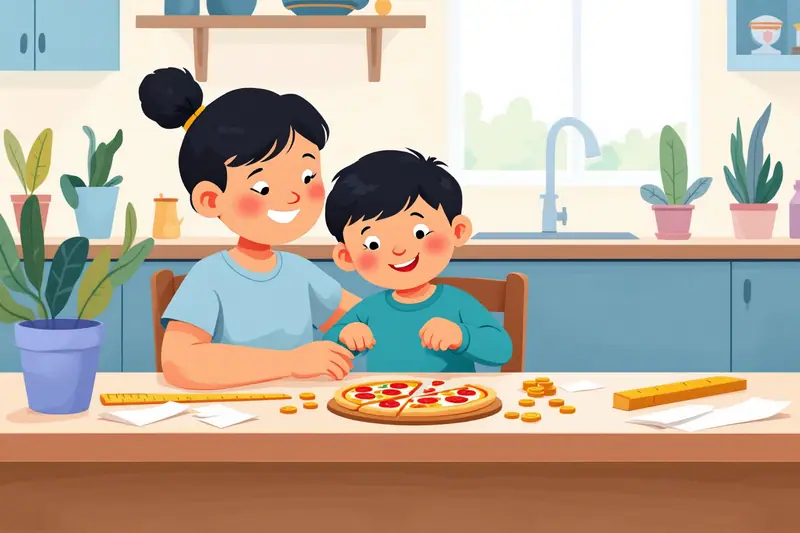
Somewhere around Grade 4, a lot of children hit a wall. They were fine with fractions when fractions meant slices of pizza. Then decimals arrive, and a little later percentages, and suddenly there are three topics, each with its own rules, and homework starts to take a long time. Parents often feel the same wall, because many of us learned these as three separate sets of procedures and never quite saw how they connect.
Here is the connection, and it is the single most useful thing to tell your child: a fraction, a decimal and a percentage can be three ways of writing the same amount. Three quarters of a dollar, 0.75 of a dollar and 75% of a dollar are all 75 cents. The money does not change. Only the writing does.
Once a child really believes that, the work becomes translation rather than memorisation, and translation is something children are quite good at.
What each format is good for
The three formats exist because each is handy for a different job.
Fractions are good for sharing and for parts of a whole you can see. Cut a cake into eight, take three pieces, you have 3/8. Recipes and measuring cups use fractions because people actually cut and pour things that way.
Decimals are good for measuring and for money, because they fit our counting system of tens. A measurement of 1.35 m fits on a ruler. A price of $4.60 fits in a wallet.
Percentages are good for comparing, because everything is turned into "out of 100." If one class has 18 children out of 24 at the field trip and another has 21 out of 30, it is hard to say which turnout is better until you write them as 75% and 70%.
The benchmarks to learn first
You do not need your child to memorise every equivalence. A small set of benchmarks carries most of the load, and the rest can be worked out from them.
| Fraction | Decimal | Percentage |
|---|---|---|
| 1/2 | 0.5 | 50% |
| 1/4 | 0.25 | 25% |
| 3/4 | 0.75 | 75% |
| 1/5 | 0.2 | 20% |
| 1/10 | 0.1 | 10% |
| 1/100 | 0.01 | 1% |
Six rows. If your child knows these the way they know their address, they can estimate almost anything. Is 0.48 more or less than a half? A little less. Is 3/5 more than 50%? Yes, because a fifth is 20%, so three fifths is 60%.
The full equivalence table
For reference, and for children who like to see the whole pattern, here is the table from halves to twentieths. Repeating decimals are rounded and marked with "about."
| Fraction | Decimal | Percentage |
|---|---|---|
| 1/2 | 0.5 | 50% |
| 1/3 | about 0.33 | about 33% |
| 2/3 | about 0.67 | about 67% |
| 1/4 | 0.25 | 25% |
| 3/4 | 0.75 | 75% |
| 1/5 | 0.2 | 20% |
| 2/5 | 0.4 | 40% |
| 3/5 | 0.6 | 60% |
| 4/5 | 0.8 | 80% |
| 1/6 | about 0.17 | about 17% |
| 1/8 | 0.125 | 12.5% |
| 3/8 | 0.375 | 37.5% |
| 5/8 | 0.625 | 62.5% |
| 1/10 | 0.1 | 10% |
| 3/10 | 0.3 | 30% |
| 7/10 | 0.7 | 70% |
| 1/12 | about 0.08 | about 8% |
| 1/20 | 0.05 | 5% |
| 3/20 | 0.15 | 15% |
Look down the table with your child and ask what they notice. Children usually spot that the fifths go up by 20% at a time, that the eighths go up by 12.5%, and that thirds and sixths never come out even. Those observations are worth more than the table itself.
Conversions children can do in their heads
A handful of mental moves cover most of what children meet in primary school.
- Tenths and hundredths are already decimals. 7/10 is 0.7. 23/100 is 0.23. The denominator tells you how many places.
- Percentages are hundredths. 23% is 23/100, which is 0.23. Moving between decimals and percentages is just reading the same digits with a different label.
- Make the denominator 10 or 100. 3/5 is the same as 6/10 (double top and bottom), so it is 0.6. 7/20 is 35/100 (multiply by 5), so 0.35.
- Halve your way down. If 1/2 is 50%, then 1/4 is 25% and 1/8 is 12.5%.
- Use 10% as a stepping stone. To find 30% of 40, find 10% (4) and multiply by 3. To find 5%, halve 10%.
Two models that live in every house
Money
A dollar is 100 cents, so money is a ready-made hundred grid. Put a quarter, a dime and a nickel on the table. Each one is a fraction, a decimal and a percentage of a dollar at the same time.
| Coin | Cents | Fraction of a dollar | Decimal | Percentage |
|---|---|---|---|---|
| Quarter | 25 | 1/4 | 0.25 | 25% |
| Dime | 10 | 1/10 | 0.1 | 10% |
| Nickel | 5 | 1/20 | 0.05 | 5% |
When a child is unsure whether 0.3 beats 0.25, ask whether they would rather have three dimes or a quarter. The decimal confusion vanishes because the coins are real.
A metre stick
A metre stick shows tenths and hundredths as lengths. Each 10 cm block is a tenth of a metre. Each centimetre is a hundredth. Ask your child to point to 0.4 m, then to 40% of the stick, then to 2/5 of the stick. They land on the same spot every time, and you can watch the moment when that stops being surprising.
The classic misconceptions
These come up in nearly every family I have talked with, and none of them means a child is behind.
- Longer means bigger. A child thinks 0.125 is bigger than 0.5 because it has more digits. Write 0.500 next to it, or go back to money: 12 and a half cents against 50 cents.
- Bigger denominator means bigger fraction. 1/8 looks bigger than 1/4 because 8 is bigger than 4. Fold two equal paper strips, one into quarters and one into eighths, and compare a single piece of each.
- Reading decimals as whole numbers. "Zero point twelve" is a trap. Say "twelve hundredths" instead, and the size of the number is right there in the words.
- 0.5 and 0.05 are the same. Five tenths against five hundredths: on a hundred grid, 50 squares against 5.
- Percentages over 100 are impossible. They are not. If a plant was 20 cm and is now 30 cm, it is 150% of its old height. Older children enjoy this one.
A worked example: which is bigger, 3/8 or 0.4?
This is a good question to try with a Grade 5 or 6 child, because there are several sensible ways in and they all agree.
Method 1 is to turn the fraction into a decimal. 1/8 is 0.125, so 3/8 is three times that: 0.375. Compare 0.375 with 0.400. The 4 tenths beats the 3 tenths, so 0.4 is bigger.
Method 2 is to turn both into percentages. 3/8 is 37.5%. 0.4 is 40%. 40% is bigger.
Method 3 is to turn the decimal into a fraction. 0.4 is 4/10, which is 2/5. Now compare 3/8 with 2/5 using a common denominator of 40: 3/8 is 15/40 and 2/5 is 16/40. 16/40 is bigger, but only just.
Method 4 is to use benchmarks. Both are a bit less than a half. 3/8 is one eighth short of a half. 0.4 is one tenth short of a half. An eighth is a bigger gap than a tenth, so 3/8 is further from a half, which makes it smaller.
Method 4 is the one I like best, because it needs no written work. But when a child finds a method on their own, let them use it, and then show them that another method gives the same answer. That agreement is what convinces them the three formats really are the same amount.
Practice at home, a little at a time
Short and regular beats long and rare. Five to ten minutes, a few times a week, does more than a long Sunday session. Some ideas:
- Price tags at the grocery store. "This is 25% off. What fraction is that? How much do we save?"
- Weather and sport numbers. A 60% chance of rain is 3 chances in 5. A player who scores 7 out of 10 shots has a 70% rate.
- Recipe scaling. Halving a recipe that calls for 3/4 cup of milk is a real fraction problem with a real reward at the end.
- A card game. The fraction version of the Math War card game uses an ordinary deck to make two-card fractions and compare them.
- A game with built-in hints. The Summit Climb game asks children to match and compare all three formats, and shows fraction bars and a hundred grid when they slip.
- Your own fridge table. Write the six benchmarks on a card and stick it up. Point to it when the numbers come up in conversation.
If you want a few physical tools for this, such as fraction strips or a hundred grid, the resource shelf for grown-ups lists the types that are worth having.
When to slow down
If your child is upset or stuck, go back to the physical models. A child who can show you 2/5 of a metre stick and two fifths of a paper strip is learning something real, even if the written work is still messy. The symbols can catch up with the understanding. They rarely work the other way around.
Then pick one amount for the week, say three quarters, and look for it everywhere: in the measuring cup, on the clock (45 minutes is three quarters of an hour), in a pocket of coins, and on the metre stick at the 75 cm mark.
Filed under: Math at Home

Tobias writes about number sense, fractions and the small daily habits that make primary math feel less like a wall of facts. He tests every game idea at a kitchen table first.