Home For grown-ups Math at Home
Notes for grown-ups
Times Tables Without Tears: A Calm Six-Week Plan for Families
By Tobias Quarrie8 min read
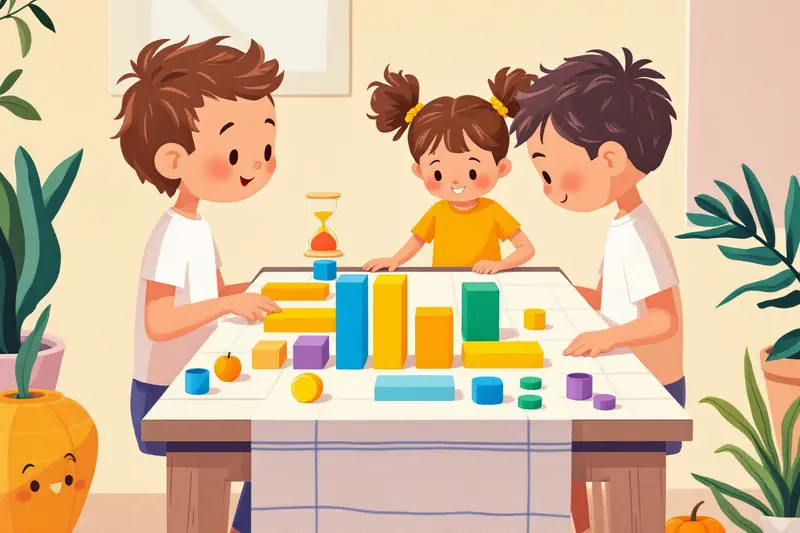
Times tables cause more tears at kitchen tables than almost anything else in primary math. I have seen it happen, and I have caused it, back when I thought the job was to drill a child through all 100 facts as fast as possible. It does not work that way for most children. What works is slower at the start and much faster later: understand what multiplication is, learn the facts in a sensible order, use the facts you know to reach the ones you do not, and practise a little every day.
This guide walks through each of those steps and ends with a six-week plan. It is written for families with children in roughly Grades 2 to 5, which is when most children meet the tables.
Understanding comes first
A child who only memorises "6 x 7 = 42" as a string of sounds has nothing to fall back on when the memory fails. A child who knows that 6 x 7 means six groups of seven can always rebuild it. So before any drilling, spend a week or so on what multiplication actually is.
Equal groups
Multiplication is about equal groups. Three bags with four pears in each is 3 x 4. Put real things in real groups: socks in pairs, eggs in a carton, cars in rows of five. Ask "How many groups? How many in each group? How many altogether?"
Arrays
An array is objects arranged in rows and columns. Lay out buttons in 3 rows of 4. Count them. Then turn the tea towel a quarter turn: now it is 4 rows of 3, and it is still 12 buttons. That single turn teaches one of the most useful facts in all of multiplication, that 3 x 4 and 4 x 3 are the same. It halves the number of facts to learn.
Arrays also show why some facts are easy to split. A 6 x 7 array can be cut into a 5 x 7 array and a 1 x 7 array: 35 and 7, which make 42.
Skip counting
Skip counting is counting in steps: 3, 6, 9, 12, 15. It builds the sequence of multiples that children later recall directly. Skip count while climbing stairs, while bouncing a ball, while setting out spoons. Fives and tens come almost for free. Twos follow from counting pairs of shoes.
The order to learn them
There is no rule that says tables must be learned 1, 2, 3 and so on. A much kinder order starts with the easiest and uses each new table to open up the next.
| Order | Table | Why it comes here |
|---|---|---|
| 1 | 10s | Children already count by tens; the pattern is obvious |
| 2 | 5s | Half of the tens; also the minutes on a clock |
| 3 | 2s | Doubles, which most children half know already |
| 4 | 4s | Double the 2s |
| 5 | 3s | A new pattern, but small numbers |
| 6 | 9s | Several handy patterns (below) |
| 7 | 6s | Double the 3s, or 5s plus one more group |
| 8 | 8s | Double the 4s |
| 9 | 7s | By now most 7 facts are already known from other tables |
By the time a child reaches the 7s, the only new facts left are 7 x 7. Everything else (7 x 2, 7 x 3, 7 x 4, 7 x 5, 7 x 6, 7 x 8, 7 x 9) has already turned up in another table. That is a lovely moment to point out: "You only had one new one left."
Derived facts: using what you know
A derived fact is one you work out quickly from a fact you already know. These are not cheats. They are how most adults who are good at mental math actually think.
- Double the 2s to get the 4s. 4 x 7 is double 2 x 7: double 14 is 28.
- Double the 4s to get the 8s. 8 x 6 is double 4 x 6: double 24 is 48.
- Double the 3s to get the 6s. 6 x 8 is double 3 x 8: double 24 is 48.
- Use the 5s for the 6s. 6 x 7 is 5 x 7 plus one more 7: 35 + 7 is 42.
- Use the 10s for the 9s. 9 x 7 is 10 x 7 take away one 7: 70 - 7 is 63.
- Use a square you know. 7 x 8 is 7 x 7 plus 7: 49 + 7 is 56.
A worked example, for the fact that seems to give children the most trouble:
6 x 8. "I don't know it." Do you know 5 x 8? "Forty." Then 6 x 8 is one more group of 8. "Forty-eight." Or: do you know 3 x 8? "Twenty-four." 6 is double 3, so double 24. "Forty-eight again."
Two different paths, the same answer. When children see that, they trust the method.
The 9s patterns
Nines have a set of patterns that children love, and that also make them feel clever.
| Fact | Answer | Tens digit | Ones digit | Digits add to |
|---|---|---|---|---|
| 9 x 2 | 18 | 1 | 8 | 9 |
| 9 x 3 | 27 | 2 | 7 | 9 |
| 9 x 4 | 36 | 3 | 6 | 9 |
| 9 x 5 | 45 | 4 | 5 | 9 |
| 9 x 6 | 54 | 5 | 4 | 9 |
| 9 x 7 | 63 | 6 | 3 | 9 |
| 9 x 8 | 72 | 7 | 2 | 9 |
| 9 x 9 | 81 | 8 | 1 | 9 |
Ask your child what they notice. The tens digit is always one less than the number being multiplied (9 x 6 starts with 5). The two digits always add to 9. The tens go up while the ones go down. There is also the finger trick: hold up ten fingers, fold down the sixth finger for 9 x 6, and you see 5 fingers on the left and 4 on the right, so 54.
Let children discover these rather than being told. The pattern is the reward.
Short daily practice beats long weekly sessions
Five to ten minutes a day is more useful than an hour on Sunday. Memory for facts builds through regular, spaced, low-stakes practice, and a long session mostly builds a child's dislike of the topic.
Good practice is varied. One day it is a card game, another day a few questions in the car, another a game on the screen. Ideas:
- Times Tables War. Each player flips two cards from a deck (face cards out, aces as 1) and multiplies. The bigger product wins. For a gentle version, fix one factor: every card is multiplied by 4. The guide to card games that teach math has more of these.
- Space Bricks. The Space Bricks mission puts times tables to 10 x 10 into a short space mission, so children answer quite a few facts in a few minutes without feeling quizzed.
- Fact of the day. Write one tricky fact on a sticky note on the fridge. Ask it at breakfast, at dinner and at bedtime. By the third time, it usually sticks.
- Array hunt. Egg cartons, muffin tins, window panes, tiles on the bathroom floor. "How many rows? How many in each? How many altogether?"
- Your child as the quizmaster. Children who ask the questions also learn the answers, and they enjoy catching a grown-up out.
On choosing between screen games and table games, the piece on choosing learning games and screen time goes into what makes a game worth the minutes.
Why timed tests upset some children
Many children enjoy a timed challenge, and that is fine. For others, the ticking clock is the whole problem. Their attention goes to the time instead of the facts, they freeze, and they come away believing they are bad at math, which makes the next test worse.
At home, you have the freedom to leave the clock out. If you want to see progress, measure accuracy, not speed: "Last week you knew 30 of these. This week you know 42." Speed comes on its own as facts become familiar. If a child is truly distressed by tests at school, a quiet word with their teacher is usually welcome. You can say what you have noticed without asking for anything to change.
For grown-ups: the box below links to a shop for books or learning tools that fit this topic. If you buy through it, Megatfo may earn a small commission at no extra cost to you. The games on this site never show shops or ads to children.
A six-week plan
About ten minutes a day, five days a week. Adjust freely: if a week feels rushed, repeat it.
| Week | Focus | Daily routine | End of week check |
|---|---|---|---|
| 1 | What multiplication means | Equal groups and arrays with buttons; skip count by 2, 5 and 10 | Can build 3 x 4 and 4 x 3 as arrays and explain they match |
| 2 | 10s, 5s and 2s | Skip counting games; fact of the day; one card game | Answers 10s, 5s, 2s without counting most of the time |
| 3 | 4s and 3s | Double the 2s for the 4s; skip count by 3s on the stairs | Uses doubling to explain any 4s fact |
| 4 | 9s | Discover the 9s patterns; finger trick; Times Tables War with a fixed 9 | Explains one 9s pattern in their own words |
| 5 | 6s and 8s | Derived facts from 3s, 4s and 5s; Space Bricks | Can find 6 x 8 two different ways |
| 6 | 7s and mixed review | Point out that only 7 x 7 is new; mixed card games | A friendly mixed set of 20; note which facts are still slow |
At the end of week six, most children will have a handful of facts that still need a moment. That is completely normal. Write those on sticky notes, one per day, and keep playing the games your child liked best.
When things go wrong
If tears start, stop for the day. Nothing useful is learned after that point, and the memory of a bad session lasts longer than any fact. Go back to something your child can do easily, like skip counting by fives, and finish there.
Tomorrow, lay out twelve buttons on the tea towel and ask how many different arrays your child can make with them.
Filed under: Math at Home

Tobias writes about number sense, fractions and the small daily habits that make primary math feel less like a wall of facts. He tests every game idea at a kitchen table first.