Home For grown-ups Learning Through Play
Notes for grown-ups
Choosing Learning Games and Making Screen Time Worth It
By Adaeze Morrow8 min read

Every parent I know has had the same small moment of doubt. Your child is quiet, absorbed and tapping away at something called a "learning game", and you wonder: is this actually teaching anything, or is it a slot machine with cartoon animals? The honest answer is that it depends on the game, and you can usually tell within ten minutes of watching if you know what to look for.
This piece is a practical guide to that ten minutes, plus the harder part: deciding how much screen time is reasonable and how to make the limits stick without a nightly battle.
What a good learning game actually does
Strip away the graphics and a good learning game has a simple shape. It asks the child to do one thing that matters (add two numbers, match a French word to a picture, spell a short word), tells them clearly whether they got it right, and gives them a slightly harder version once they are ready. That is it. Everything else is decoration.
Here are the qualities I look for, in plain terms.
A clear goal the child can say out loud
Ask your child, "What are you trying to do in this game?" If the answer is "make ten with the cards" or "find the five differences", good. If the answer is "get more gems" or "I don't know, I'm just tapping", the learning is probably buried somewhere under the rewards, if it is there at all.
Feedback that teaches
Getting it wrong should show the child something useful, like the right answer, a hint or a second try. A buzzer and a frowning face teach nothing except to guess faster. The best feedback is quick and calm: "Not quite. 7 and 3 make 10. Try the next one."
Difficulty that follows the child
A game that stays at the same level forever is either boring or impossible. A good one gets harder when your child is succeeding and eases off after a run of misses, or lets you choose the level yourself.
An ending
This one surprises parents. Good learning games have a natural stopping point: a round ends, a story finishes, a level is complete. Games built to keep children playing for as long as possible avoid endings on purpose. There is always one more chest, one more streak, one more daily reward.
Nothing taken from the child
No account needed, no name, no photo, no location, no chat. A child practising subtraction does not need to tell anyone who they are. Our own games on this site keep no scores, need no sign-in and store nothing, which you can read more about on the about page.
The checklist
Print this, or keep it in your head. Play the game yourself for five minutes first, then watch your child for five more.
| Question | Good sign | Warning sign |
|---|---|---|
| What is the skill? | You can name it in one sentence | You cannot tell |
| What happens after a wrong answer? | A hint, the answer or a retry | Just a sound and a lost life |
| Does it get harder? | Yes, gradually, or you can pick a level | Same level forever, or a sudden wall |
| Is there an end? | Rounds, stories or levels that finish | Endless play with daily streaks |
| What are the rewards? | Small, quick, tied to the task | Coins, chests, prizes unrelated to learning |
| Does it ask for money mid-game? | Never | "Buy now" offers, extra lives for sale |
| Is there advertising aimed at kids? | None | Pop-ups, videos to watch for rewards |
| Does it ask for personal details? | No | Name, age, photo, email, location |
| Can children talk to strangers? | No chat at all | Open chat or "friends" lists |
| Would you play it for five minutes? | Yes, it is a decent puzzle | It is mostly animation and waiting |
Three or more warning signs and I would quietly delete it. One warning sign might be fine, depending on which one. A game with no levels is a small problem. A game with open chat is a big one.
Warning signs worth knowing by name
Some features are designed to keep children playing or paying, and they are worth recognizing.
Loot boxes and mystery prizes
The child earns or buys a box with a random reward inside. The thrill comes from the not knowing, which is the same pull as a lottery ticket. It has nothing to do with learning.
Timers that push
"Come back in 4 hours to collect your reward!" or "Your streak ends in 20 minutes!" These are built to pull a child back to the screen at times you did not choose. A good game waits patiently until you return.
Chat and friends lists
Even with filters, chat opens a door to strangers. For primary-age children I would treat any chat feature as a reason to say no.
Fake urgency and pressure
Flashing "Hurry!" banners, countdowns that are not part of the actual puzzle, characters that look sad when your child stops playing. Children feel these much more than adults do.
Rewards that swamp the task
If a child answers one sum and then watches 30 seconds of fireworks and coin animations, the ratio is wrong. The math should be most of the time on screen.
Co-playing: the biggest upgrade you can make
The single thing that makes screen time more useful is a grown-up sitting next to the child some of the time. Not all the time. Nobody has that many evenings. But ten minutes alongside changes the game from a solo activity into a conversation.
Here is what co-playing sounds like in practice, during a round of Spot the Difference:
Grown-up: "How are you deciding where to look?" Child: "I just look all over." Grown-up: "Want to try the top half first, then the bottom?" Child: "Okay. Oh, the bird is gone up there." Grown-up: "Nice. That top-half trick works for reading a page too."
You are not teaching the game. The game teaches itself. You are naming the thinking, which helps it travel off the screen. A few useful questions for any learning game:
- "How did you know that one?"
- "What would happen if you picked the other answer?"
- "Can you show me the hardest level you can do?"
- "Teach me how to play."
That last one is gold. Children who explain a game understand it better, and they love being the expert.
Time limits that actually work
There is no magic number of minutes. A short burst of a well-made math game is a different thing from an afternoon of video clips. Still, children do better with a predictable shape to the day, and so do the grown-ups who have to enforce it. Here is a rough starting point many families find workable for school-age children on school days:
| Age | Learning games on a school day | Notes |
|---|---|---|
| 4 to 5 | 10 to 15 minutes | With a grown-up nearby |
| 6 to 8 | 15 to 20 minutes | Often split into two short sessions |
| 9 to 12 | 20 to 30 minutes | Child can help choose the game |
These are starting points, not rules. Adjust for your child and your household. What matters more than the number is how the time ends.
Make the stopping point part of the game
Endings cause most of the fights. A few things that help:
- Agree on rounds, not minutes. "Three rounds of the tree game" is easier to stop than "fifteen minutes", because the child can see the finish coming.
- Give a one-round warning. "This is your last round" said before the round starts, not in the middle.
- Stop at a success. If the last round goes badly, offer one easy one to finish on.
- Have the next thing ready. Screens are hardest to leave when there is nothing on the other side. A snack, a walk, the deck of cards on the table.
- Keep devices out of bedrooms. A simple household rule that saves many arguments at 8 p.m.
Swap some screen time for the same game off-screen
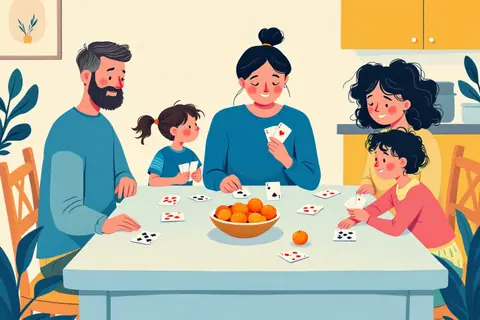
Many good learning games have a paper or card version that is just as useful, sometimes more. If your child loves a sums game on screen, try the deck-of-cards versions in our guide to card games that teach math. The skill is identical, the screen is gone, and you get to play too.
When your child only wants the flashy ones
This happens. A child who has played games full of coins and fireworks may find a calm, simple learning game boring at first. Give it a week. Play it with them. Let them pick between two good options rather than between a good one and a flashy one. And be honest: "That game wants you to keep playing so it can sell you things. This one just wants you to get better at sums." Children respect being told how things work.
A quick plan for a new game
When a new game comes into the house, try this:
- Day one: you play it alone for five minutes and run the checklist.
- Day two: you play it together with your child for ten minutes.
- Day three: they play alone while you are in the room, and you ask one question at the end.
- End of week one: decide together whether it stays.
A game that passes this test earns its spot. A game that fails it can go, and you will have a clear, calm reason to give your child when they ask why. Most of the time, the answer is something they can see for themselves: "Remember how it kept asking for money? That's why."
Filed under: Learning Through Play, School and Family

Adaeze writes about learning through play: card games, puzzles, memory games and the kind of screen time that leaves kids thinking. She keeps a shelf of games that cost nothing to make.