
Home For grown-ups School and Family
Notes for grown-ups
A Homework Routine for Primary Kids That Survives Weeknights
By Adaeze Morrow7 min read
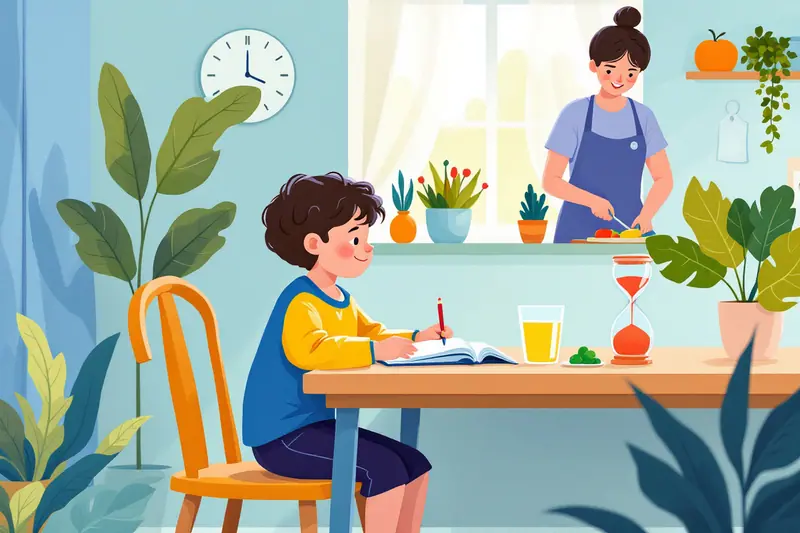
Homework at our house used to happen in a fog between the backpack hitting the floor and dinner hitting the table. Someone was hungry, someone could not find a pencil, someone (usually me) was saying "just do the page" in a voice that did not help. What changed things was not a stricter rule or a fancier desk. It was a routine boring enough that nobody had to think about it.
This is that routine, broken into its parts, with the reasons behind each one so you can bend it to fit your family. Primary homework is usually short: a reading log, a page of sums, a spelling list, a project once in a while. The point at this age is less about the work itself and more about building the habit of sitting down, starting and finishing.
Pick the time of day, then protect it
There is no perfect time, but there is a perfect time for your child, and it is worth a week of experiment to find it. The three usual options:
| Time | Works well for | Watch out for |
|---|---|---|
| Straight after school, after a snack | Kids who like to get it over with | Tired, hungry children who need to run first |
| After an hour of play, before dinner | Most children aged 6 to 9 | Play running long, dinner pressure |
| After dinner | Older primary kids with activities | Bedtime creep, overtired meltdowns |
Whatever you choose, the snack comes first. A hungry seven-year-old cannot spell "because". After the snack, many children need to move: a run in the yard, a dance in the kitchen, ten jumping jacks. Our article on five-minute brain breaks that still teach has plenty of quick ones that slip in nicely before the pencil comes out.
Once you find a time, keep it the same on school days. The routine works because it stops being a decision. "Is it homework time?" turns into "it's homework time", and the arguing drops away.
A set place, stocked once
The place matters less than its sameness. A corner of the kitchen table works as well as a desk, sometimes better, because a grown-up is nearby. What helps:
- A spot with good light and not much traffic.
- The television off and devices out of reach, unless the homework needs one.
- A small box or basket with everything in it: two sharpened pencils, an eraser, a ruler, crayons, a glue stick, scissors and a few sheets of scrap paper.
The box is the secret. Half the lost time in homework is the search for a pencil. Stock it once on a Sunday, and the hunt stops.
How long it should take
Teachers set very different amounts, and children work at very different speeds, so treat this as a rough guide rather than a rule. A common rule of thumb is about ten minutes per grade, which looks like this:
| Grade | Rough time on a school night | Usually includes |
|---|---|---|
| Kindergarten | 5 to 10 minutes, mostly reading together | Sharing a book, naming letters |
| Grade 1 | 10 to 15 minutes | Reading log, a short word list |
| Grade 2 | 15 to 20 minutes | Reading, a page of sums or spelling |
| Grade 3 | 20 to 30 minutes | Reading, math practice, a spelling list |
| Grade 4 | 30 to 40 minutes | As above, plus small projects |
| Grades 5 and 6 | 40 to 60 minutes | Longer assignments, studying for quizzes |
If your child is regularly taking twice as long as this, it is worth looking at why. Is it the work, the time of day, or the getting started? We will come back to that.
Reading usually counts as part of homework at this age, and it is the part I would protect most. Even once children can read alone, a few minutes of being read to builds vocabulary they cannot reach yet, which our piece on reading aloud to older kids explains.
Helping without doing it for them
This is the hard part. You want them to succeed, and doing it yourself is faster. Resist. The goal is for your child to do the thinking while you sit nearby and make the thinking easier.
What helping looks like:
- Read the instructions together, then ask your child to say in their own words what they have to do.
- Do the first question side by side, with them holding the pencil.
- Step back for the rest. Stay in the room, chop the carrots, fold the laundry.
- Check at the end, not during. Point to a question and ask "can you check this one again?" rather than "that's wrong".
What it does not look like: holding the pencil, spelling every word, or fixing errors so the page looks perfect. Teachers need to see what your child can actually do. A page full of your corrections hides that.
When they are stuck
Every child gets stuck. What matters is having a plan for it, so being stuck does not turn into tears. Teach this order, and write it on a card for the homework box:
- Read the question again, out loud.
- Look at the example on the page, or in your notebook.
- Try something, even if you are not sure.
- Ask a grown-up.
- If nobody can help, circle it and move on.
Here is what step four can sound like with a Grade 3 child:
Child: "I don't get this one. 7 x 6." Grown-up: "What do you know that is close?" Child: "7 x 5 is 35." Grown-up: "So 7 x 6 is one more seven." Child: "35, 36, 37... 42!" Grown-up: "You did that. I just asked a question."
That last line matters. Children should leave the table feeling they solved it, because they did. If times tables come up a lot, our guide to times tables without the tears has more ways in.
And step five is allowed. A circled question with a note saying "we tried, she was not sure about carrying" is more useful to a teacher than a perfect answer you supplied.
Getting started: the biggest hurdle
For many children, the hardest part of homework is the first two minutes. They sharpen the pencil, need water, need the bathroom, need to tell you about recess. A few things that help:
- Use a sand timer or kitchen timer for a short sprint: "Let's see what you can do in ten minutes." Short and visible beats long and vague.
- Start with the easiest item, so the first win comes quickly.
- Sit down with them for the first minute, even if you are not helping. Your presence is a signal.
- Keep the chatting for after. "Tell me about recess when you finish the page. I want to hear it properly."
Talking with the teacher
You and the teacher are on the same team. A short note goes a long way, and most teachers would much rather hear early than late. Good reasons to get in touch:
- Homework regularly takes much longer than expected, or causes tears most nights.
- Your child does not understand the instructions even after you read them together.
- Something at home (a new baby, a move, an illness) is making evenings harder for a while.
- You do not speak the language of the homework, for example in French immersion, and need to know what you can do instead.
Keep notes short and factual: "He worked on the math page for 25 minutes and finished 4 of 10 questions. He was confused about the second section." That tells the teacher exactly what happened, without blame.
If your child is worried about learning or attention in a way that goes beyond homework, talk to the school or your doctor.
A weekly planner you can copy
Primary homework is often spread across the week. A simple planner on the fridge helps everyone see what is coming. Here is the kind of layout that works:
| Day | Reading | Math | Spelling or words | Other | Done |
|---|---|---|---|---|---|
| Monday | 15 min, log signed | Page 12 | New list, copy once | ||
| Tuesday | 15 min | Card game, 10 min | Practise 5 words | Library book back | |
| Wednesday | 15 min | Page 13 | Practise 5 words | ||
| Thursday | 15 min | Review page | Practise quiz together | Pack gym clothes | |
| Friday | Free choice book | Quiz at school | Project check-in |
Let your child tick the "Done" column. Ticking things off is satisfying at any age, and it gives them ownership. On Sunday evening, spend five minutes together filling in the next week.
Some weeks, the math row can be a game instead of a worksheet. Short, focused games count as practice, and sometimes they are exactly what a tired child needs on a Tuesday.
The end-of-day check
The routine finishes with a two-minute check before bed. Not a review of the homework, just a quick run through:
- Is the homework finished, or noted as not finished?
- Is it in the folder?
- Is the folder in the backpack?
- Are any forms signed?
- Is the backpack by the door?
Make it the same five questions every night, and after a few weeks your child will start asking them on their own. When the backpack is already sitting by the door at 8 p.m., with the signed reading log tucked inside, you will know the routine has taken hold.
Filed under: School and Family

Adaeze writes about learning through play: card games, puzzles, memory games and the kind of screen time that leaves kids thinking. She keeps a shelf of games that cost nothing to make.