Home For grown-ups Math at Home
Notes for grown-ups
Kitchen Fractions: Halving and Doubling a Recipe With Kids
By Tobias Quarrie8 min read
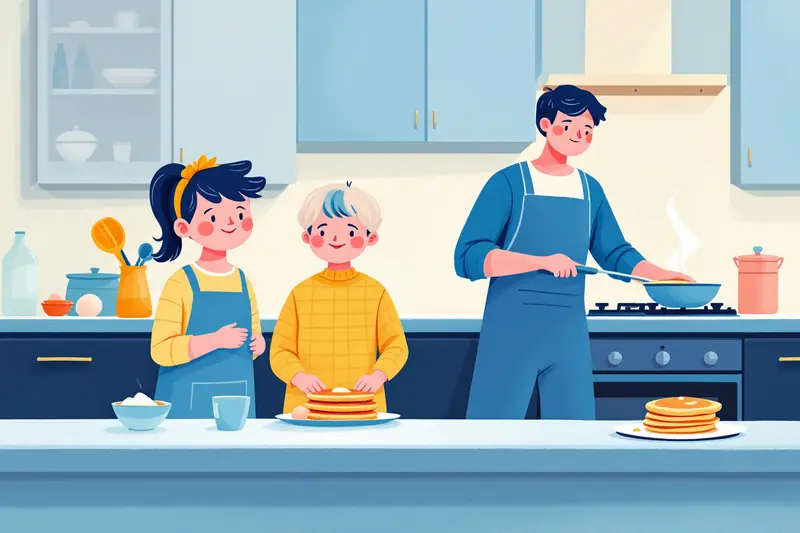
Ask a Grade 3 child what a quarter is and you may get a blank look. Hand the same child a set of nested measuring cups and ask how many of the little one fill the big one, and you will get an answer in about thirty seconds, usually with flour on the floor. The kitchen is the one room in the house where fractions are not a school topic. They are just how you make supper.
This piece walks through the fraction ideas that come up naturally while cooking, then works one pancake recipe all the way through: halved, doubled and scaled by one and a half. Bring the measuring cups and a tolerance for mess.
Your measuring cups are already a fraction kit
A standard set of dry measuring cups is 1 cup, 1/2 cup, 1/3 cup and 1/4 cup. Many sets add a 2/3 and a 3/4. In Canada most cups are also marked in millilitres, with 1 cup sold as 250 mL, which gives you a neat second set of numbers to compare.
Before you cook anything, try these four experiments with rice or dried lentils (they pour cleanly and sweep up easily):
- How many 1/4 cups fill the 1 cup? (4.) Write it as 1/4 + 1/4 + 1/4 + 1/4 = 1.
- How many 1/4 cups fill the 1/2 cup? (2.) So 2/4 is the same as 1/2. This is equivalence, and it is the idea children most often miss on paper.
- How many 1/3 cups fill the 1 cup? (3.) Then ask the trick question: is 1/3 bigger or smaller than 1/4? Most young children say smaller, because 3 is smaller than 4. Let them pour and find out.
- Fill the 1/2 cup and the 1/4 cup and tip both into a clear glass measuring jug. Where does it reach? (The 3/4 line, or 175 to 190 mL depending on the jug.)
Those four pours cover unit fractions, equivalence, comparing and adding. If your child has played the Summit Climb game, you can point out that the same halves and quarters show up there as decimals and percentages, and that 1/2 cup and 0.5 of a cup are the same scoop.
Spoons, millilitres and the 1/8 problem
Measuring spoons usually come as 1 tablespoon, 1 teaspoon, 1/2 teaspoon and 1/4 teaspoon. Some sets include 1/8. The relationships are worth putting on the fridge:
| Measure | Equals | Metric (rounded) |
|---|---|---|
| 1 cup | 16 tablespoons | 250 mL |
| 1/2 cup | 8 tablespoons | 125 mL |
| 1/4 cup | 4 tablespoons | 60 mL |
| 1/8 cup | 2 tablespoons | 30 mL |
| 1 tablespoon | 3 teaspoons | 15 mL |
| 1 teaspoon | 1/3 tablespoon | 5 mL |
| 1/2 teaspoon | 2 mL | |
| 1/4 teaspoon | 1 mL |
The odd one for children is the tablespoon to teaspoon link. Three teaspoons make one tablespoon, not two or four, so halving a tablespoon gives you 1 1/2 teaspoons. That is a lovely little problem for a 9-year-old: you cannot pour half a tablespoon with any spoon you own, so how do you do it?
Metric makes scaling easier, and it is worth saying so out loud. Half of 250 mL is 125 mL. Half of 175 mL is 87.5 mL, which you round to 90. Children quickly notice that millilitres are just whole-number division, while cups make you think in fractions. Both are useful.
The base recipe
These are thin, plain pancakes, about 10 cm across. The base recipe makes about 8.
| Ingredient | Base amount (8 pancakes) |
|---|---|
| Flour | 1 cup (250 mL) |
| Sugar | 1 tablespoon (15 mL) |
| Baking powder | 2 teaspoons (10 mL) |
| Salt | 1/4 teaspoon (1 mL) |
| Egg | 1 |
| Milk | 3/4 cup (175 mL) |
| Melted butter | 2 tablespoons (30 mL) |
Cook on a pan or griddle at medium heat. An electric griddle set to about 190 °C works well. If you are making a big batch, keep the finished ones warm on a plate in the oven at about 90 °C.
Worked example: half, double and one and a half
Here is the same recipe scaled three ways. I like to make the child write the new amounts on a scrap of paper before anyone opens the flour bag. The table below is what a finished sheet looks like.
| Ingredient | Half (4) | Base (8) | One and a half (12) | Double (16) |
|---|---|---|---|---|
| Flour | 1/2 cup | 1 cup | 1 1/2 cups | 2 cups |
| Sugar | 1 1/2 tsp | 1 tbsp | 1 1/2 tbsp | 2 tbsp |
| Baking powder | 1 tsp | 2 tsp | 3 tsp (1 tbsp) | 4 tsp |
| Salt | pinch (1/8 tsp) | 1/4 tsp | 3/8 tsp | 1/2 tsp |
| Egg | 1/2 egg | 1 | 1 1/2 eggs | 2 |
| Milk | 3/8 cup | 3/4 cup | 1 1/8 cups | 1 1/2 cups |
| Butter | 1 tbsp | 2 tbsp | 3 tbsp | 4 tbsp (1/4 cup) |
A few of these deserve a conversation, because they are where the real thinking happens.
The half recipe, milk: half of 3/4 cup is 3/8 cup. Nobody owns a 3/8 cup. So break it down: 3/8 is 1/4 plus 1/8, and 1/8 cup is 2 tablespoons. Use the 1/4 cup and then 2 tablespoons. In metric it is simpler: half of 175 mL is about 90 mL.
The half recipe, egg: you cannot crack half an egg. Beat one egg in a cup, then pour out about half. Children enjoy this more than you would expect, and it shows that fractions apply to things that are not already in pieces.
One and a half, milk: 1 1/2 times 3/4. Rather than multiply fractions, do it in two parts: 3/4 cup (the one) plus half of 3/4, which you already worked out is 3/8. So 6/8 + 3/8 = 9/8, which is 1 1/8 cups. In practice that is 1 cup plus 2 tablespoons. This is a good stretch for Grade 5 or 6, and it is easier to follow when the cups are on the counter.
Double, baking powder: 4 teaspoons. A child who knows the spoon table might say "1 tablespoon and 1 teaspoon," which is the same thing in fewer scoops.
Here is how that talk sounded at our counter, with a 10-year-old doing the one-and-a-half column:
Grown-up: We need one and a half times the milk. What is the milk in the base? Child: Three quarters. Grown-up: So one lot of three quarters, plus half a lot. Child: Half of three quarters is... three eighths? Grown-up: How do you know? Child: Because quarters cut in half are eighths, and there were three of them. Grown-up: Lovely. So three quarters plus three eighths. Child: Three quarters is six eighths. Six and three is nine eighths. That is more than a cup. Grown-up: By how much? Child: One eighth. Two tablespoons.
Nobody said "find a common denominator." It happened anyway.
Jobs by age
Not every child is ready for every part of cooking. A rough guide, which you will adjust for your own child:
| Age | Math jobs | Kitchen jobs |
|---|---|---|
| 4-5 | count eggs, fill the 1 cup with a scoop, "is it full or half full?" | pour, stir, crack eggs into a separate bowl |
| 6-7 | count how many 1/4 cups make 1 cup, double a recipe with whole numbers | level off cups with a knife, measure spoons, whisk |
| 8-9 | halve a recipe, use the spoon table, read millilitres on a jug | read the recipe aloud, measure everything, set a timer |
| 10-12 | scale by 1 1/2 or 3, convert cups to mL, work out cost per pancake | ladle batter, flip with supervision, plan the batch |
Levelling a cup is underrated. A heaped cup of flour can be a quarter more than a level one, and showing a child that difference by tipping both onto a scale (if you have one) makes the point that measuring is about equal amounts, which is exactly what a fraction is.
Safety around the stove
The math is the easy part. Keep it safe:
- The grown-up handles the hot pan and the oven, and children under about 8 stay on the counter side, not the stove side.
- Turn pan handles inward so nobody catches a sleeve on one.
- A step stool should be wide and steady, and at the counter, not in front of the burner.
- Melted butter from the microwave is hotter than it looks. Let it sit for a minute before a child pours it.
- Raw batter contains raw egg and raw flour, so no tasting before it is cooked.
- Wash hands after cracking eggs, every time.
Older children who flip pancakes should use a wide, long-handled turner, and you should stand next to them for the first few weeks.
Beyond pancakes
Once a family has scaled one recipe, the idea transfers. A soup that serves 6 becomes a soup that serves 4 (multiply everything by 2/3, which is a real challenge). A cookie recipe that makes 24 can be cut in thirds. A muffin tin of 12 is a natural array for twelfths: 3 blueberry, 3 banana, 6 plain, so a quarter, a quarter and a half.
If you want to keep going away from the stove, homemade fraction strips from our guide to manipulatives use the same halves, quarters and eighths, and the article on fractions, decimals and percentages shows how 3/4 cup, 0.75 and 75% are one amount.
Our last batch was the one-and-a-half column, which gave us 12 pancakes. The child who did the arithmetic pointed out that with four of us, that was three each, then claimed the small scrap of leftover batter as "one quarter of a pancake, which is mine."
Filed under: Math at Home

Tobias writes about number sense, fractions and the small daily habits that make primary math feel less like a wall of facts. He tests every game idea at a kitchen table first.